


“They wanted her”, performer Jim Caruso—who made his Broadway debut in Liza’s At The Palace! alongside Liza Minnelli—recalls his friend having observed after spending an evening at a party where she could tell that those gathered wanted to be around Liza! the effervescent red sequined star, not simply Liza the person. Director Bruce David Klein’s feature documentary Liza: A Truly Terrific Absolutely True Story, which world premiered at Tribeca 2024 and is now opening in theaters, attempts to show us both Lizas in this lively, affectionate yet nuanced portrait of the icon.


As Laurent Bouzereau did with his subject Faye Dunaway in his recent HBO documentary, Faye, Klein opens his film with a behind-the-scenes moment from a new on-camera interview with Liza before “action” has been called. It is an approach that recurs several times throughout the film and mostly shows the star being exacting about the placement of the camera. She is an Oscar-winning director’s daughter after all—who grew up observing Vincente Minnelli at work on Hollywood sets as we see in archive images—and she knows her angles.
It is in these unfiltered moments, when the spotlight isn’t directly on her, that Klein offers us a glimpse of the unguarded, less showbiz Liza. Unsurprisingly, she is just as warm and sparkling albeit more low-key and at ease, and not afraid to ask for what she wants. Even when she doesn’t expect what she is saying to make it into the finished film, she is of course aware that she is on a set and busy connecting with and entertaining everyone in the room. When quiet is called for she amusingly screams, “Shut the fuck up!”

Early on in the film, Liza remarks that she has always had good instincts when it comes to the people she has chosen to surround herself with throughout her career, and Klein proves to be no exception. There is an engaging collaborative spirit between subject and the off-camera filmmaker, such as in the moment where Liza praises Klein, “How smart of you to show me this right now”. The director has put an iPad in front of her playing archive footage of her singing in the back of a car with her godmother, MGM vocal coach, performer, and Eloise author Kay Thompson.
Following the death of her mother Judy Garland in June 1969—six days before the Stonewall Rebellion broke out late in the night following her funeral—Liza and Thompson became inseparable, with the older woman serving as a mentor both personally and professionally. A gem of life advice that Liza recalls Kay bestowing upon her was a caution: “Don’t go around with people you don’t like”.

One of the most satisfying and substantial strands of the film is its exploration of how Liza’s stage and screen persona and her approach to her craft were shaped, and Thompson was clearly essential in that development. While some inspired editing by Jake Keene and Alexander J. Goldstein underscores the influence that Charles Aznavour (“the French Sinatra”) had on Liza’s burgeoning performance style. Liza’s lifelong friend Mia Farrow credits Aznavour with helping Liza to find more light and shade in her interpretation of songs. She also recalls that Sinatra, Farrow’s husband in the 60s, had commented that “not everything has to be the National Anthem”, referring to Liza’s earlier approach to taking on a song. While we see the Liza of today emphasize that telling the story of a number is just as important to her as hitting the right notes.


Klein goes on to illustrate how crucial her friend lyricist Fred Ebb—who wrote the quintessential Liza numbers “Liza with a ‘Z'” and the “Theme from New York, New York” from Scorsese’s 1977 movie musical—was in propelling her to superstardom. She won an Emmy for the television concert, Liza with a ‘Z‘, that Ebb had conceived and written for her, choreographed and directed by another major force in Liza’s life, Bob Fosse. It followed their celebrated collaboration on Cabaret, which saw Liza take the Best Actress Oscar for her indelible portrayal of Sally Bowles.


A compelling sequence skillfully blends archive behind-the-scenes footage and photography from the set of Cabaret with a raft of on-camera interviews extolling the performer’s dedication to the role and her ability to handle herself with the demanding Fosse. It is fascinating to hear Liza recall the details of how the physical manifestation of the character took shape, along with her co-star Joel Grey’s reminiscences of what it was like to perform alongside her, and Farrow’s insights into how her friend channeled her own vulnerability into the performance. Vulnerability is a word that comes up a lot in her friends’ descriptions of the star, something that they see when she’s off-stage but also acknowledge that it is a quality that allows her audience to connect with her on such a deep level when she is performing.
We also hear one of today’s Broadway stars, Darren Criss—currently appearing at the Belasco in the critically acclaimed Maybe Happy Ending—vividly recall the first time he encountered Liza’s Sally Bowles as a theatre kid and how entranced he was by her. Criss also shares a fun anecdote about getting to spend an evening hanging out with Liza, with her acknowledging what a fun time she’d had by saying Criss was “in the gang” now.


Another delectable, dynamically paced sequence chronicles legendary fashion designer Halston’s role in creating Liza’s distinctive look, their close friendship and storied nights spent at Studio 54. This leads to addressing one the darker periods in Liza’s life, with Klein incorporating archive chat show appearances of Liza being admirably frank in discussing how she became addicted to prescription drugs and alcohol. Through being so candid, she helped to counter the sensationalism of the media coverage of her time in rehab, while also destigamtizing addiction more generally.

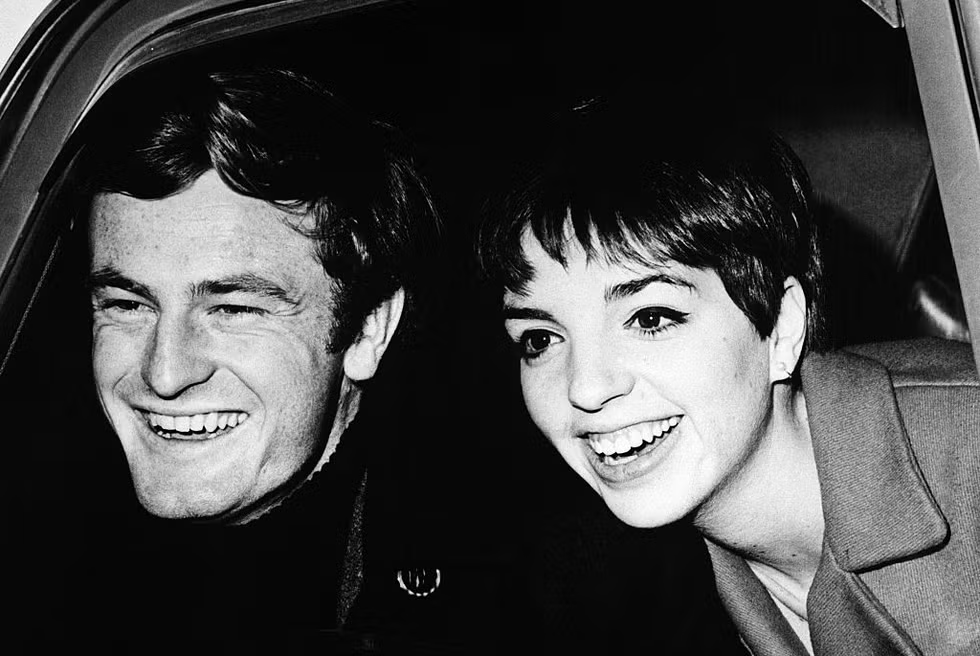
When we hear an off-camera Klein suggest, “Let’s talk about relationships, marriages…” Liza interrupts with the perfect quip, “Give me a gay break, will ya?!” Before bursting into an infectiously hearty laugh, and adding, “I’m sorry, cut that!” Though I’m sure she knew that she’d given Klein one of the best lines in the film. Clearly she would rather not dwell on that aspect of her life, having spent decades enduring intrusive press questions about it, so it is largely left to her friends to discuss her significant romances and four marriages. It proves to be a delicately handled but insightful approach. For instance, despite Liza’s joke, her friend, performer and archivist Michael Feinstein, describes her discovery that her first husband Peter Allen was gay in sensitive, relatable terms, adding that she was “truly devastated” when she found him with another man. While we hear Liza’s fond recollections of being around Allen and her admiration for him as a musician and fellow performer.
Liza’s last husband, the late David Gest, does not come off so well, with him being portrayed as someone who took advantage of the star when she was at a low ebb. Allan and Arlene Lazare, who have been friends with Liza since the early Seventies, recall the time that Gest cleared out all of Liza’s possessions from her New York apartment while she was away on tour. As Feinstein sums up Gest’s impact on his friend’s life he paraphrases another Hollywood legend saying, “Bette Davis said, ‘you should only speak good about the dead’, well, David Gest is dead, good.”


Klein also touches upon Liza’s miscarriages and the fact that she never became a mother. Again, this is sensitively handled, with the Lazares sharing how close Liza is to their family, while another friend, Oscar-nominated makeup artist Christina Smith, acknowledges that she sometimes observes a loneliness in Liza that she attributes to her not being a mother or a grandmother. We also see the insensitively of the media’s questions that Liza has been faced with over the years on the subject.
When it comes to contemplating what it must have been like for Liza to have grown up with one of the world’s most famous people as a mother, who was battling her own demons, and going on to spend a lifetime in the public eye, Klein turns to NYU professor and psychoanalyst Ann Pellegrini for her observations. While Feinstein goes into the complexities of their mother-daughter relationship, which is deftly illustrated with archive footage. As Liza herself succinctly puts it, “Being Judy Garland’s daughter is not a lot of laughs”. Klein acknowledges the inescapable impact that Judy had on her daughter’s life without taking his focus off Liza herself, while archive interviews show her frustration at constantly having to field questions about her mother.

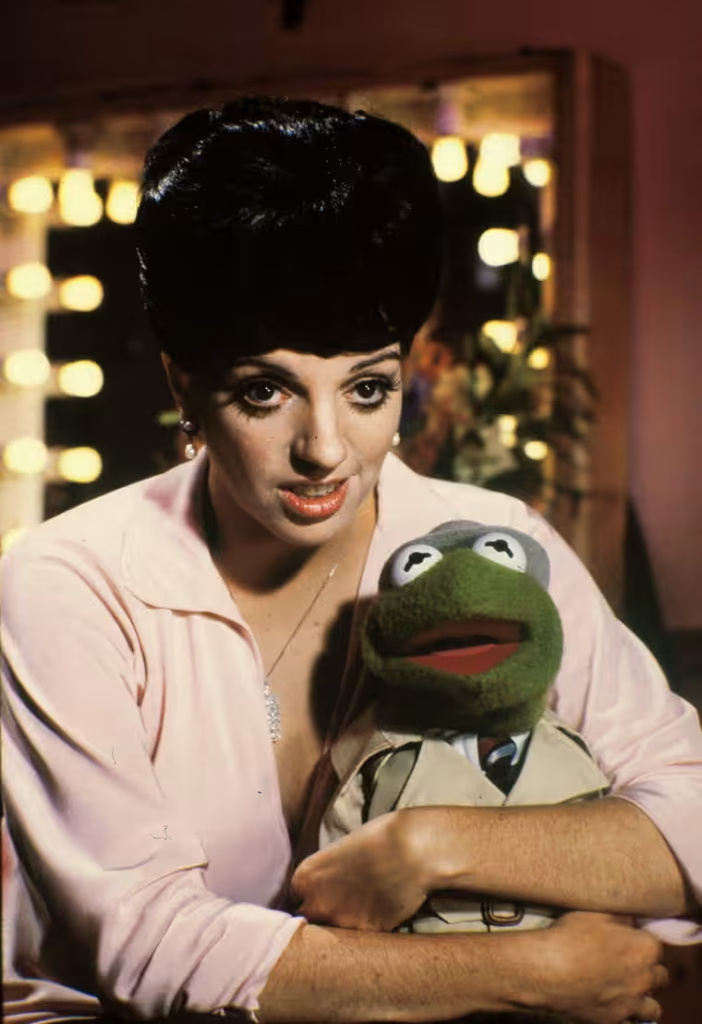
Given the vast scope of Liza’s career, Klein wisely choses not to attempt to include it all and largely keeps to Liza’s early development as an artist and the remarkable decade that she had professionally in the 1970s that would secure her status as a certified icon. This means that the era is covered in real depth, but inevitably there are significant omissions. There is no mention of her role in 1969’s The Sterile Cuckoo, which earned Liza her first Oscar nomination, the hugely popular Arthur opposite Dudley Moore in 1981, her collaboration with Pet Shop Boys on her ninth studio album Results in 1989, or more recently her memorable, scene-stealing cameo in Sex and the City 2. Though there is a vibrant montage that takes in many of the career highlights not included to acknowledge that the documentary only covers a fraction of what she has achieved. I was left wanting more, but then again isn’t that how every star should leave us feeling when they exit the stage? I also immediately wanted to rewatch Liza with a ‘Z’ and Cabaret, and put on her albums. Another sign of a great documentary about an artist is that it makes us want to revisit and rediscover their work with the new perspective and appreciation we have been given.
Part of what makes this film such a delight is getting to spend time in Liza’s company and reveling in the carefully curated archive footage, some of which has never been seen publicly before. Klein pulls off the delicate balance of letting Liza tell her own story, while also meaningfully allowing us to peer beneath the surface of her showbiz persona. Filled with thoughtful and concise contributions from those who know her best, like her sister Lorna Luft and peer Chita Rivera, what emerges is an image of loyal and dedicated friend. Klein’s documentary lives up to its title. It’s a sparkling tribute to her unique talent as an artist, as well as an intriguing excavation of what helped to create her as a performer. It is a hugely entertaining film, and yes, it’s truly terrific.
By James Kleinmann
Liza: A Truly Terrific Absolutely True Story opens at New York’s IFC Center on Friday, January 24th with filmmaker Q&As at select shows opening weekend, followed by Laemmle’s Royal in Los Angeles and Town Center in Encino on Friday, January 31st with a national rollout to follow from Zeitgeist Films in Association with Kino Lorber.
Liza: A Truly Terrific Absolutely True Story receives its Australian Premiere at Queer Screen’s 32nd Mardi Gras Film Festival in Sydney on Wednesday, February 19th at 6:30pm. Bob Fosse’s Oscar-winning 1978 classic musical Cabaret starring Liza Minnelli screens at MGFF 2025 on Thursday, February 20th at 6:45pm. Head to queerscreen.org.au for more information and to purchase tickets.


