


When Mexico City-based multidisciplinary artist Efraín Mojica took their friend, writer and poet Rebecca Zweig, home for the holidays to the small rural Michoacán town of Penjamillo where they grew up, she was immediately taken by the sights and sounds of the local annual Christmas Day rodeo event, the jaripeo. That was back in 2018. Over subsequent years they regularly returned to Penjamillo together, becoming co-directors as a feature documentary began to take shape. The result not only enthrallingly captures the colour and energy of the jaripeos themselves, but penetrates beneath the surface to bring a distinctly queer perspective to the gatherings, while examining what they have to say about the hypermasculine culture they celebrate.

Mojica and Zweig blend kinetic vérité footage with beautifully dreamlike abstract sequences and striking use of Super 8mm film to create a lyrical, layered, and intoxicating visual language. The film is deeply personal with Mojica central to its narrative as they reflect on growing up queer in Penjamillo and meet with some queer men who still live there. These include Noé, a ranchero who embodies and revels in the traditional machismo image but opens up to reveal a more vulnerable side. While the unapologetically femme and flamboyant Joseph is not only accepted but embraced as an integral part of his community as a church leader, businessman, and makeup artist.


Following the world premiere of Jaripeo at Sundance, the film made its international debut at the 76th Berlinale where co-directors Efraín Mojica and Rebecca Zweig spoke exclusively with The Queer Review’s editor James Kleinmann over tacos and tequila at the Berlin premiere party. During the conversation, the filmmakers discuss the genesis of the film, how they decided upon its structure, and share the queer culture that has had the biggest impact on them.
James Kleinmann, The Queer Review: Efraín, what was it like growing up queer in Penjamillo and what’s it like to return there now as an adult?
Efraín Mojica: “It was very strange to grow up as a queer little twinkie kid in such a macho dominated space. I’m a soft person and in all these gathering places you’re told to sit up straight and uncross your legs. You have to sit like a man. That was always in the back of my head, even as an adult. Until a few years ago, I would still have my legs crossed and my limp wrist and then I’d check myself and be like, ‘Oh, no, I have to sit up straight and uncross my legs.’ It was almost subconscious because that’s just how we are raised. Part of the process of making this film was realizing all of these things and how they were still a part of me. How when I left the town, I wanted to break free from all of this and say none of this is me. But some of it is me. It’s about coming to terms with what I find beautiful in how I was brought up and what makes sense to me about it.”


I know the film was shaped over several years, but was that autobiographical element always there?
Rebecca Zweig: “It wasn’t. We both started behind the camera without a fully formed vision of what the film was going to be. We each come from different artistic backgrounds and we learned what the film wanted to be by making it. There were a few things in our first shoot, like the cornfield sequence for instance, that happened because Efraín was just like, ‘I need to do this scene’. It was clear that it was coming straight from his gut in a ‘I need to do this’ kind of way.”
“As we continued to develop the film, it became more and more apparent that Efraín needed to step in front of the camera, which I know was really difficult for them to do. It also changed what our dynamic was to some degree. Two people disagreeing behind the camera is very different to having this expanded relationality. I think it brought a lot more care and respect to our work together.”
“At the end of out first shoot, we shot the scene in the truck at the vista where Efraín is reflecting because we needed to have a dialogue on what we’d experienced so far. We kept having those conversations between us in the truck every time we did a shoot over the next four years. But it wasn’t until the edit that those scenes emerged as a narrative through line for how the rest of the movie fit together.”


Efraín: “At the beginning, I was opposed to being in the film. I didn’t want to make it all about myself. This was a film about my town, about portraits of these people, these moments, and these memories. It wasn’t about me. But then I realized that all of these memories are also mine. I was expecting my friends to share these things with me, but then it dawned on me that I was sharing things with them as well. I couldn’t ask them to open themsleves up in front of the camera without me doing so too.”
“It was very helpful to be on the same level with them so we could have casual conversations. All of the conversations in the film were shot on days when we were naturally hanging out at the jaripeo or at the quinceañera. When we were partying, we’d say, ‘OK, let’s talk about this’, as opposed to a more formal set up where it’s like, ‘Sit here. We’re going to point the camera at you. Now…tell me why you’re gay!'”

Rebecca: “We were never interested in making that kind of film. Even at the beginning of the process, when we didn’t know exactly what we wanted to do, we knew that we didn’t want to do talking heads. Also, we weren’t interested in having an exploitative relationship with our protagonists. We wanted it to feel like everyone was discovering something and everyone was being vulnerable together through the process of making the film.”


So you saw them as collaborators rather than as more traditional documentary subjects?
Rebecca: “Exactly. All of the the stylized scenes that you see in the film were constructed with our protagonists. That was the type of film we wanted to make.”
The film is so rich, nuanced and moving. How did you land on the jaripeo as a way in to explore all the different themes you touch on and the conversations that you have with your protagonists?
Efraín: “I think it’s because that’s where we hung out in my town for the first time when Rebecca came to visit Penjamillo. We went to the jaripeo to party because that’s what everybody does on Christmas Day. It was also the perfect stage where this performance of hypermasculinity happens. Everybody does it. The queers do it. The moms do it. They get their three year old babies to do it. It provided so much fabric to cut from. The jaripeo is so beautiful and cinematic. The fashion is impeccable. There are so many amazing styles on display there. It was about having so much substance there to work from.”
There’s drama there too with the bull riding.
Efraín: “Yeah, the riders are risking their lives.”

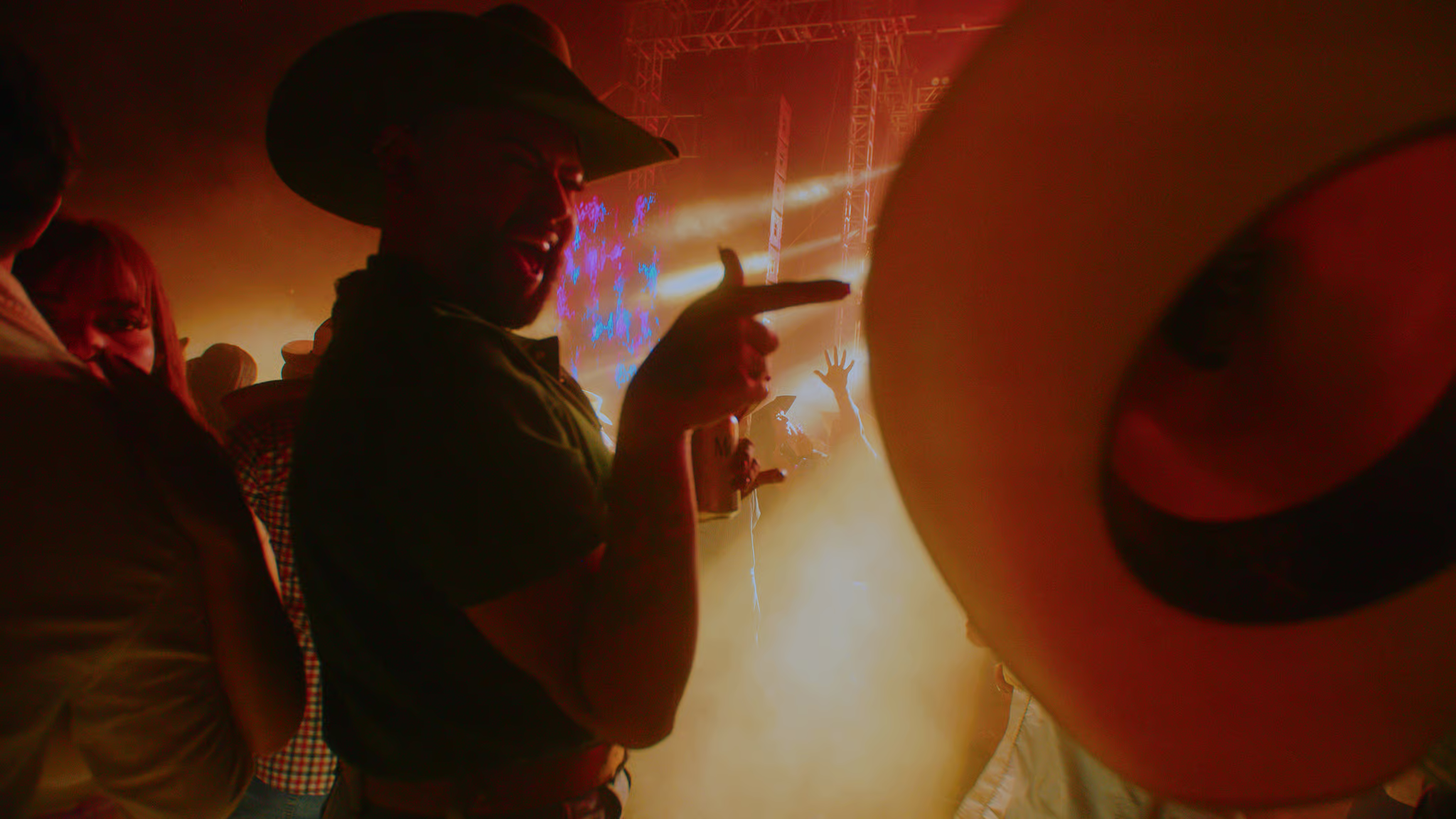
Rebecca: “When I first went to the jaripeo with Efraín, I was immediately struck by it. I started writing things down and talking to people about it. I had a desire to do something inspired by it, not quite knowing what that was yet. Something that really interested me before we’d even started our collaboration, was that there is a lot of migration that happens from this town to the US, but people come back to Penjamillo to visit their families for Christmas. So a lot of people at the jaripeo are home for the holidays. It struck me that the jaripeo was this performance of masculinity—in this very specific way of being a Mexican cowboy—that almost felt like it was like a lesson. ‘Don’t you remember what it’s like to be like a Mexican man?’ I was really interested in that aspect of performance.”
“When we started to talk about collaborating on something, Efraín was like, ‘Sure, but it’s got to be gay!’ That was where everything came together for us. Seeing that there is this entire subculture that’s happening within the hypermasculine performance. Our producer Sarah Strunin, who is an old friend of ours, was also there with us from the beginning and what everyone brought to the table clicked together very quickly.”


What was your approach to the visual style of the film—which is beautiful and really varied—including the use of Super 8?
Efraín: “I knew that I wanted Super 8 to be a part of it from the beginning. I’ve always loved film. I learned how to use a camera with my dad’s 35 millimeter as a 10 year old kid, but I’d never done it in motion. I knew that I wanted this textural element to be a part of the film aesthetically, but then once we found its motif it really made sense. It was me holding the Super 8 camera the whole time. It was my queer lens. We go from the wide-angle vérité of seeing the very traditional straight world, where if you don’t pay attention you don’t realize that there’s the gay shit happening underneath. The super 8 is a magnifying glass to show people all of these moments that are happening and that have been happening since the jaripeo started. Bringing that footage into the edit, it was immediately obvious that the Super 8 was the queer lens, then it starts abstracting into queer mind, queer memory, and queer desire. There’s a lot of desire in the Super 8.”
Rebecca: “We decided that the Super 8 was completely Efraín’s vision, that it was their lens. Then it was in the edit—because I come from poetry—where the idea of finding narratives through aggregation and images rhyming with each other made a lot of sense to me. We started developing the Super 8, not into a plot, but into something that had a narrative arc. We started with the really tangible desire elements of it. Then the next time the Super 8 comes in is when we’re with Joseph and there’s a desire for friendship. Then it expands out into landscape and it’s about this desire for freedom and peace in a way. These threads emerged that developed in this really beautiful way.”
Efraín: “There’s so much Super 8 footage. There are about 20 rolls with amazing stuff on them. I wish everything could be in the film.”


Maybe you could do an installation with it or create some way for people to see it?
Efraín: “Actually we do have an installation in mind using just the Super 8.”
Rebecca, I was intrigued by a phase that you used at the Q&A to describe the look and soundscape: “an excess of vérité”. What did you mean by that?
Rebecca: “It has to do with the disparate visual elements that we were using. This film is essentially about cruising. How can you make a vérité documentary about cruising? And why would you want to? I mean, on an artistic level. What always drew me to poetry was trying to capture something in an excess of language and when it came to making a documentary it was about trying to capture something that you can’t through traditional documentary or through vérité. Bringing all of these elements together, working with the sound design in order to call attention to certain things, the way that we jump between vérité and the stylized scenes and the Super 8 in order to allow things to encounter each other, could say something that was more interesting to me than a straightforward observational documentary could.”


How did you find Noé and Joseph?
Efraín: “Noé found us.”
Rebecca: “He literally did.”
Efraín: “He approached us after this dance party we were at and we became really good friends immediately. Once we started talking about finding subjects, I mentioned it to Noé and he was like, ‘Yes! I’d like to be in front of the camera. I am a star!’ The fact that we were already close gave us easy access to talk together on camera. When he first mentioned the story about coming out to his mom off-camera we were hanging out, so it was easy to bring it back up in front of the camera. That meant it wasn’t as stressful for him.”
“Joseph really blew all of our hats off our heads. He kept surprising us. He just shines as a person. He’s a fashion diva. Then we found out that he’s the president of his local church. He’s the choreographer of the folkloric ballet company of the town. He’s the makeup artist of everyone’s quinceañeras and weddings. He’s a Zumba instructor. He’s a community leader that is a presence in everybody’s lives and he’s respected for it.”

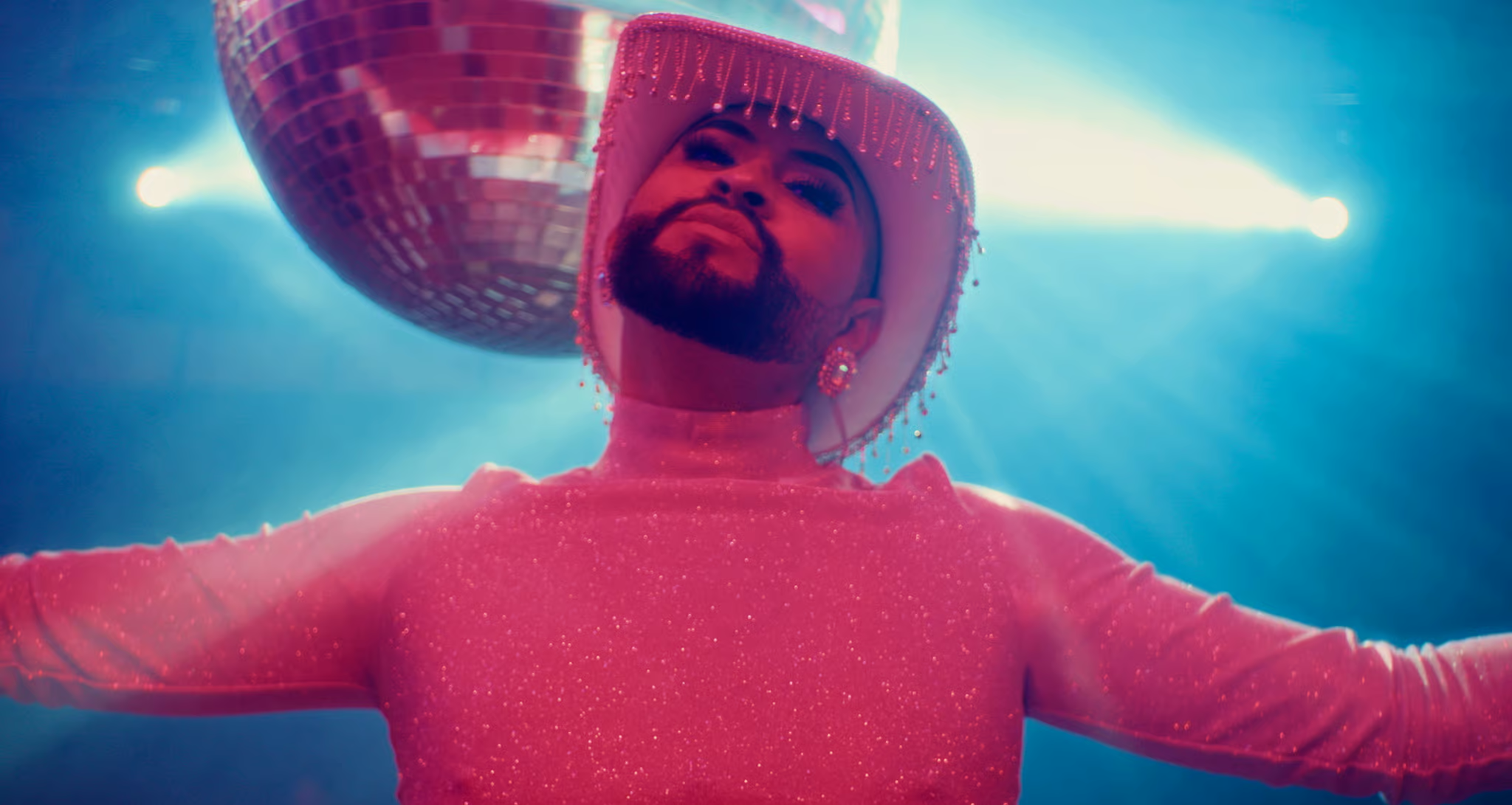
Rebecca: “We met Joseph for the first time at a jaripeo. From the outset, we really wanted to talk to him but it took a year and a half for us to actually get him on camera because he’s so busy. He’s like the person in a children’s book who literally does everything in the town. You can see how people react to him in the film when he’s in the jaripeo, he’s waving at everyone and everyone’s engaging with him. He has really changed the way that people see queer femme people in the town. Everyone was so excited that we were working with him and he loves the film.”
Efraín: “They say that he has paved the way for younger queer generations in the town to feel comfortable in their own flesh. He was the first one that took the glares from the older more traditional men and women. Having seen Joseph wearing all these feathers, when they see somebody else who is queer they’re like, ‘Oh, they’re like Joseph and he’s cool.’ Everybody sees him being so assured and comfortable with who he is. The queer community really loves Joseph for that.”


Then there’s a different dimension with how the rodeo clown in drag fits into the machismo world of the jaripeo. It’s not so much about queerness with his character, but more to do with tapping into the perceived comedy of him being a man in a dress isn’t it?
Rebecca: “Yeah, he very much is a man in a dress. Arturo Calderón, who is known as “La Pirinola”, has been a rodeo clown at these jaripeos in Michoacán for over 40 years. He has different personas and the drag character we see him perform is only one of them. We see him every time we go to the jaripeo. He’s always there. What I loved about that scene is that you can tell how much he’s enjoying doing this character and how the crowd also interacts with him in a really loving way. It’s ambiguous. I don’t know what his sexual orientation is, but I enjoy the question that he is. In a small town like this that is traditionally masculine, I enjoy seeing how things can exist simultaneously. These old versions of living and these new ones, but they’re not rejecting each other. They’re all in this shared space and all part of this community and there’s something really beautiful in that.”
Efraín: “The crowd is playing and fooling around with him, especially all the riders. Arturo is a talented rider himself. He has a ranch and horses. He knows how to control an animal. So there is also a level of respect that he attracts for that.”


What is it like to be sharing your hometown with the world through the film?
Efraín: “I have always loved sharing my hometown with my friends. From the first year I moved to Seattle, I’ve had friends come visit me with my family. Every Christmas, different friends would come back with me, to the point where my friends in Penjamillo would be like, ‘Where’s your gringo? Which gringo did you bring this time?!’ That’s how Becca came one year. My family loves my friends and I love my friends in Penjamillo, so I’m happy to be sharing the town in this new capacity.”


Last question for you, what’s your favorite piece of LGBTQ+ culture, or a person who identifies as LGBTQ+; someone or something that’s had an impact on you and resonated with you?
Efraín: “I have two. One is Xavier Dolan because he makes family dramas that are very rich and complicated, but also mixes it with pop culture and music. It’s very cinematic, but also very fun. I can relate because there was family drama in my house, but it was also fun and cute. One of my favorite queer films is Francis Lee’s God’s Own Country about a guy in a small town who is repressed and has anger issues. That was me for such a long time. Then this beautiful Romanian man comes into his life. When I saw it, I was like, I want that story to be mine. To have someone to come and help you free yourself from your repression.”


Rebecca: “An artist, filmmaker, and writer who has been a huge inspiration for me for a long time is Derek Jarman. Caravaggio blew my mind. Blue and his book Chroma, and also his Garden book, were so important to me when I was starting out as an artist. They were all such formative works for me. I’m really stoked because we’re competing for the Teddy Award here at the Berlinale and Jarman won the Teddy four times. I’m proud to be in that tradition now with our film.”
By James Kleinmann
Jaripeo received its world premiere at the Sundance Film Festival and its iternational premiere at the 76th Berlinale. Upcoming festival screenings include BFI Flare: London LGBTQIA+ Film Festival on March 21st and 22nd, 2026.
