

As an 18-year-old newly arrived in New York City, Emmy-nominated filmmaker Zackary Drucker encountered a photograph of European disco icon Amanda Lear and—like so many before her, including David Bowie—was immediately captivated by her beauty, crediting her as her “original trans archetype.” Twenty years later, the director was approached by producer Noah Levy with the opportunity to meet the star at her home in the South of France and to make a film about her. The result is the poignant and compelling feature documentary, Enigma, which places Lear’s story alongside that of the late British trailblazer April Ashley, who proudly embraced her trans history, while Lear has consciously denied and obfuscated her own for decades.

Following Drucker’s previous directorial work such as the Peabody, GLAAD and Sundance award-winning The Stroll, co-directed with Kristen Lovell, QUEENMAKER: The Making of an It Girl on Hulu, and the Independent Spirit Award-nominated four-part HBO series The Lady and The Dale, Enigma sees the filmmaker continue to engage with complex and nuanced trans stories that challenge our expectations.

Having world premiered at Sundance in January, Enigma received its international premiere at the 39th annual BFI Flare: London LGBTQIA+ Film Festival in March and will debut on HBO and stream on Max on Tuesday, June 24th, 2025. Here, Zackary Drucker speaks exclusively with The Queer Review’s editor James Kleinmann about her approach to interviewing Amanda Lear, getting to know April Ashley through previously unseen archive footage and through meeting those who knew her, and what she has taken from both of their stories to navigate today’s hostile climate for trans people.

James Kleinmann, The Queer Review: congratulations on another fascinating and deeply moving film.
Zackary Drucker: “Thank you. This film was a dream for me. I feel like everything I’ve made has led me to this.”

When did you first become aware of each of these women individually and what drew you to them?
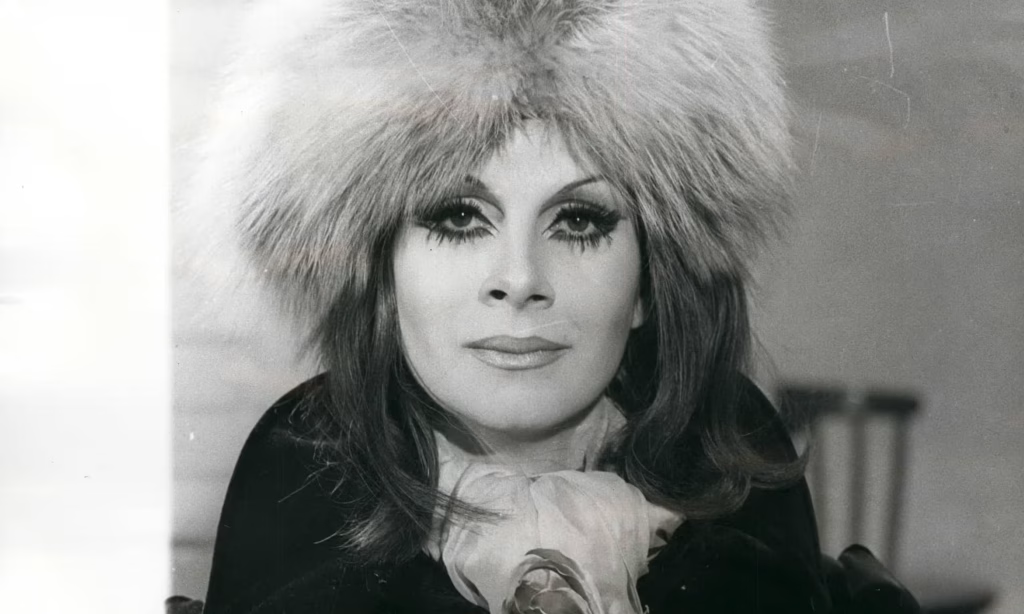
“Amanda Lear is my original trans archetype. When I was 18 I moved to Brooklyn and my first trans friend was a huge fan of disco music and she told me about Amanda Lear. She essentially said that Amanda Lear is famous for being trans and denying it. I looked her up and found a picture of her. I can tell you exactly what that photo it is to this day, it’s her modeling headshot from 1967 with drawn on, liquid liner on her lower lashes. I was aghast at how preternaturally beautiful she was and that was it for me. It wasn’t about her music, it wasn’t about her as an icon, I just couldn’t believe that such a beautiful woman could have started life not as a girl, let’s say. I hung that photo up on my bedroom wall and Amanda continued to haunt me through the years, so I think of her as my OG archetype for the woman that I then created and became.”
“I came to April later in life. With the trans tipping point in the 2010s, people in the US began to foreground her as a human rights icon and I started to understand her particular legacy to British LGBTQ folks. I read her book, The First Lady, when it was published in 2006, so that’s when I first became aware of her. The piece of April’s story that I was so compelled by was the history that included Amanda Lear. So many of the people that April included in her history are distinguished and compelling on their own, but there was an obvious story in their public feud and in one’s commitment to the truth and factual historical accuracy, and the other’s commitment to obfuscating history despite all evidence to the contrary. That was the dynamic tension that I was most captivated by and those divergent paths are emblematic of trans life in the 20th century. That’s a choice that people made and of course the dominant choice was to disappear and assimilate into society if you had the means to. Both the financial means and the physical, corporeal means, if you just happen to be a really beautiful trans woman who nobody suspects is trans.”

Why did you decide to put Amanda and April’s stories side by side?
“Amanda’s an enigma, that’s her whole persona, so I was curious about her origins and her pedigree. Where did she come from? Who is she? She won’t tell you. She doesn’t create an alternate narrative, she just starts the story in her mid-20s in Paris. So we were faithful to Amanda’s telling of her story, while providing additional context through April. April gives us the grounding narrative we need to understand what it may have been like to grow up in the ruins of World War Two in Europe for this generation of women who came of age in the 1950s and who are essentially the original group of medicalized transsexuals in the world.”

Throughout the film, we see archive interviews with April and Amanda that are often uncomfortable to watch because both women are being asked intrusive questions over and over again. What fresh perspective did you want to bring in telling their stories now?
“The million dollar question! The answer is so expansive and we could go in any number of directions to understand and unlock what it says about the era that we’re in now. In how you phrased it, it occurs to me that the questions that April faced were so much deeper and more probing. It was the really gratuitous aspects of what a surgery entails and things like that which she ended up answering and so it’s a deeper cut. Whereas Amanda, by dodging the question and in never fully admitting to her history, all the questions remained on the surface level. Because if you’re not forthcoming, it all becomes about the art of the interview, the dodging and the spin. It’s a masterclass in PR listening to Amanda. By evading the story of her own history, she was able to coast on the surface and she never has to fully delve into the more harsh questions. Whereas there’s something that’s obviously heroic about April’s approach, because it’s one that persists today. The new standard of visibility and pride is something that April modeled.”

In archive footage in Enigma, we see Amanda’s friend Salvador Dalí say something like, ‘You should never tell the truth’, and it seems like she learned a lot from him, doesn’t it?
“Yes, it’s that little tiny footnote, but it tells you everything about who Amanda becomes. This is clearly strategized. This is clearly thought-out. This is clearly some advice that she received and internalized and continues to honor to this day.”

Your interview with Amanda becomes deeply moving and quite profound. It feels more like an invitation to her to share her history rather than trying to catch her out.
“It was mutual, because she invited us so graciously into her home and was so lovely. She was so maternal and loving towards us and I was amazed at her generosity. Off-camera, she was nurturing and hilarious. She was ready to connect with us. It could have gone many ways, and certainly as a documentarian you prepare yourself for all outcomes. It was a dream to meet her. To this day I am so grateful to have had the opportunity to sit with her and connect with her because when I thought about Amanda before there was always a shadow of doubt in my mind. What if she’s being honest? What if the story about her is totally false and created to ride on her coattails? I really wanted to know who she was. That’s at the core of this film. Who is this woman that I have so admired? Who is she really? By the time I left, I knew. By the time we completed the film, I felt totally clear on who she was and it was a gift to me and now I hope it will be a gift to the world.”

How many days did you spend with her?
“We were in her home in Provence in the South of France for three days and then we met with her again last year in Paris.”

There is a beautiful moment in the film where you recite some of her lyrics to her and she seems to really appreciate that you’ve listened to them so closely. You mentioned that it was her beauty that initially drew you to her, but have you also come to admire her music?
“Oh absolutely, 1000 per percent! Aside from me showing up at her home and talking to her directly, her entire sense of self is conveyed through her music and through those interviews. The sum of all that gives you the mosaic of who she is.”

It is really powerful and poignant when you enter the frame and we see you interacting with Amanda. What made you decide to bring yourself into the film in that way?
“To some extent, including oneself as a filmmaker is embedded in documentaries as a form, and then the other piece of it is that I’m a trans filmmaker and that’s often relevant to the dynamic that I’m revealing. In this case, Amanda was always being questioned by outsiders who were not inherently empathetic to her experience, or didn’t understand it necessarily, and it changed completely when it was somebody who did understand her history and her experience and had a similar way of navigating life. I have so many ways to enter Amanda’s story and that was ultimately what led to that interaction that’s in the film. I was telling her who I was and why I showed up and why I’m interested. We couldn’t include that whole 15-minute scene, but we included the culmination of it.”
Were you able to meet April before she passed away?
“Sadly, I didn’t ever meet her. We worked with Pacific Films’ Donovan Lovell and Stephen Strout who had unseen footage of April, three interviews that had never been used elsewhere. So that was a very lucky archival source and they became our collaborators.”

Do you feel like you got to know her even better through that footage?
“Definitely. April is my Taurus predecessor. I feel a special bond with Taurean trans women and I feel more aligned in some ways with April in terms of her integrity, her commitment to her story, and her commitment to the truth. Not that she was always truthful, she definitely embellished and exaggerated things. Getting to know her was a blessing. Going to Liverpool where she grew up and staying in her favorite hotel. I also got to know April through her friends and her community and the people who really loved her and took care of her.”

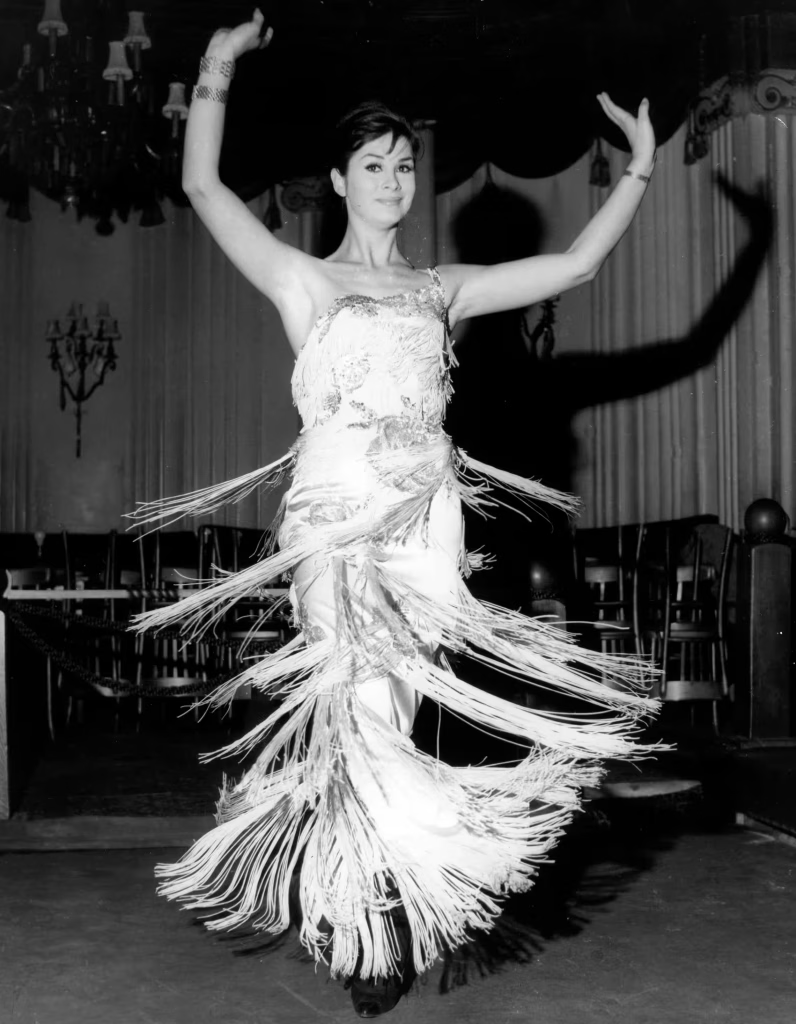
Marie-Pierre Pruvot, or Bambi, is one of April and Amanda’s contemporaries whom you spoke to. They performed together at Le Carrousel in Paris and the film includes a wealth of exquisite images and footage from that famed nightclub, what was your approach to working with that material?
“I continue to collaborate with archival producer Olivia Streisand, who worked with us on The Stroll, and she’s an incredible investigator. She’s able to source things that are obscure and some of the photos in the film have never been seen before. The things that she’s able to find astound me. The Carrousel was a monumental place. It was one of the the premiere nightclubs in Paris in the 1950s and so it does appear in films and in newspapers. Over the years, its many illustrious headlining performers became famous and Amanda takes a totally different path from many of them, but she does it because she learns from their example.”

In some ways, it feels like the Paris version of New York’s Club 82 that was explored in P.S. Burn This Letter Please.
“Yes, Club 82 opened in 1953, five years later than the Carrousel. The Carrousel deserves a documentary of its own because it’s just a sliver of the early years that we address in Enigma, but it continued to be an anchor for trans life in Paris through the 70s. The Carrousel is the birthplace of modern transsexualism.”

Enigma world premiered at Sundance and will debut on HBO later this year, how do you take that wider audience, outside of our own community, into consideration when telling our stories?
“Finding the most dynamic stories that are bigger than one person is critical to telling the story of our people to a broader audience. There has to be an element of dynamic tension and conflict in order to cross over into a broader realm of storytelling.”

As the actions of this Presidential administration unfold, I take some comfort and a sense of strength and resilience in reflecting upon our history and what we’ve endured in the past as LGBTQ+ people—both in the US and internationally—through films like Enigma, so I’m very grateful to you for making it.
“All of the work that’s undoing the gains that we’ve made over the past 15 to 20 years feels like two steps forward, one step back. We’re in it right now, but all of this can be undone too. All of these executive orders are not legislation and they will very likely never become legislation because they’re unconstitutional. It only took a week for them to change the passport policy for trans people and it will only take a week for them to reverse it when Democrats are back in power. I don’t think Republicans will ever be in power again in our lifetime after this because I think there’s going to be a full scale class war and we’re in the 99% majority of the country.”

“It’s so staggering, it’s so overwhelming, it’s so big that we can only speak to these little slivers of it, but I’m very conscious of the big picture and I’m very conscious of the way that the trans community is being scapegoated and used as a distraction to rob the American people of the structures that maintain and sustain us. I’m sure it’s going to be completely disastrous beyond our wildest dreams, but I also have hope and faith that humans are essentially collaborative, cooperative and good, and that even in the most dire, devastating circumstances, human kindness is the lasting impact. People loving and beaming light on each other is our greatest gift, along with our perseverance and resilience.”

“I don’t feel alone because I think they’re coming for everybody. They’re coming for all women. They’re coming for all people of color. They’re coming for all queer and trans people. I don’t think we’re special, we’re being used as a political device and it’s empty in many ways because it’s just a tiny piece of the bigger picture, the kind of shift that they’re trying to make, which very few people would get behind.”

Marie-Pierre Pruvot mentions an early 1900s French law aimed at restricting people from wearing clothing in public deemed inappropriate for their sex assigned at birth, which sounds eerily familiar today. It’s empowering to see older trans women like her in the film who have lived through so much.
“Yes, we’re talking about 100 years ago that these women were born. The only antidote to the notion that we popped up 10 years ago or less, or that it’s a youth phenomenon, is to present tangible examples from history to the contrary. I came of age as a woman in the George W. Bush era when we had none of these protections or legislative gains. My generation of trans folks has a lot to offer younger people because we came of age at a time when we knew that we were giving up any possibility of a normal life. I never thought I would have a legitimate job when I was a young trans person. I fully realized and recognized that this decision would make me a social pariah. I was like, I will probably lose a lot of friends and never work a regular job in my life.”

“Of course, the world changed with me and the world will continue to change and we will continue to survive ingeniously. But nobody does this because they think that it’s going to be easy. The price of admission is high and risky and painful. So what I learned from Amanda’s story is that I don’t feel like I identify as trans right now. If they know our location, let’s move our location. Let’s be something else. Let’s change the stakes of the conversation instead of playing defense all the time, instead of needing to hold onto this thing. I am a human and I’m an artist. Those are my primary identities, those are my defining identities.”
By James Kleinmann
Enigma received its world premiere at Sundance, its international premiere at BFI Flare: London LGBTQIA+ Film Festival and its New York Premiere at NewFest Pride. It will debut on HBO and stream on Max on Tuesday, June 24th, 2025.
