

Stop the press! Who is that? It’s filmmaker Vera Drew whose feature directorial debut, The People’s Joker—which she also co-wrote (with Bri LeRose), edited, and stars in—is now playing in theaters in New York, Los Angeles, and rolling out to select theaters across the United States and Canada. Following its world premiere screening in the Midnight Madness section at the 2022 Toronto International Film Festival, the movie made major headlines concerning the transformative fair use aspect of Drew’s thrillingly irreverent, “painstakingly autobiographical” trans coming of age narrative, told through the prism of parodying familiar comic book characters.
Back then there was speculation that the film might never screen publicly again, but after an award-winning international festival run last year, The People’s Joker has finally been freed for all to see, thanks to indie distributor Altered Innocence. Those headlines focusing on its legality are now dominated by a slew of articles praising the film itself, including our own five-star review and critic Richard Brody hailing it as “the best superhero movie I’ve ever seen” in The New Yorker.

Cutting her teeth in comedy at Chicago’s Second City as a performer when she was a teenager, Drew went on to establish a successful TV and film career over the past decade, earning an Emmy nomination as lead editor on Sacha Baron Cohen’s Who Is America. She co-wrote, edited, and executive produced Tim and Eric’s Beef House, and launched the duo’s streaming TV network, Channel 5, for which she wrote and directed four series, including a docuseries about public access legend David Liebe Hart, who plays Joker’s comedy hero Ra’s Al Ghul in The People’s Joker. Drew also directed the twelfth season of Tim Heidecker’s On Cinema at the Cinema.

In the film, Drew plays a painfully unfunny aspiring clown grappling with her gender identity and an addiction to Smylex while unsuccessfully attempting to join the ranks of Gotham City’s only government-sanctioned comedy program in a world where comedy has been outlawed. As mainstream success eludes her, she establishes her own anti-comedy club which leads her on a collision course with the city’s fascist caped crusader.
With electrifyingly eclectic visual, sound, and music contributions from a predominantly queer collective of artists, The People’s Joker features cameos from Heidecker, Bob Odenkirk, Maria Bamford, and Scott Aukerman, and co-stars Lynn Downey as Joker’s mom, Nathan Faustyn as Penguin, Kane Distler as Joker’s toxic boyfriend Mr. J, Griffin Kramer as Young Joker, and Christian Calloway as Dr. Crane.

Over strong coffee at a SoHo café on the morning after the New York opening of The People’s Joker, Vera Drew spoke with The Queer Review’s editor James Kleinmann in a wide-ranging, freewheeling conversation that takes in how the movie’s musical theatre number came together, editing the final cut, originally writing the role of Joker’s mom for an alternative rock icon, her homage to Return to Oz, her “father figure” John Waters, and her deep love for Twin Peaks. So pour yourself a cup of damn fine coffee, grab a slice of cherry pie, and enjoy the ride.
James Kleinmann, The Queer Review: as we’re speaking the morning after the film began its theatrical release, I have to ask what it’s like to finally have the movie out in theaters?
Vera Drew: “It feels so good today. I was not on planet Earth at all last night. Getting it out there was a really long time coming and the lead up over the last month was non-stop because I was finishing the movie again. By the time last night rolled around, I was like, ‘What even is this and what is happening?!’ I think it went well though. Making the film was such a personal experience and it feels like something is out of my system now in a way that I’ve never felt before. I feel like I literally gave birth to something but it took four years. Not to say that I’m stronger than a cis woman, but you know!”

Touching on this being a different edit to what people would have seen at festivals and secret screenings, what were your guiding principles when you were creating this final version of the film?
“It was the most boring pass when you think about it on paper, because it was the final legal pass at it, and I was doing clearances. There’s a lot of art in it that falls under fair use, but with some of it I needed to finally pay for stock that I’d found five years ago. So it was actually kind of fun to go through it because I got to dismantle the movie again from the inside out and remember what the process of building it as a whole was like.”
“Every version we’ve screened—in my opinion and my lawyer’s opinion—was always a legal cut of the movie, but this final pass was really about getting it completely bulletproof. After art, that came down to the music. Originally, in the earlier versions you saw of the film it had all cover songs in it, which we had recorded because I was under the assumption that we could fair use a lot of those because they were used in a context that was very commentary focused.”

“We’re still able to use a Gary Glitter song in the movie because, what Gary Glitter is going to ask me for money? No, I don’t think so. Also, there’s a fair use argument because it was used in the movie that The People’s Joker is parodying. We weren’t able to do that with every single song though, so the entire soundtrack pretty much changed. Which also ended up changing the entire edit of the movie. The movie flows a lot more now. It’s funny because yesterday somebody said to me yesterday that it was a lot tighter, but only about 30 seconds came out of it. When I watch it now I think it breathes more. There’s something about it that feels a bit more pure now that we have a lot more original music and particularly the end credits song.”
“It’s a wildly different cut, but I’m so glad that people like you got to see it before because—even to my own emotional distress at times—I was always very publicly making the movie in this way that I think a lot of people aren’t into and don’t want to witness happen. But it was the only way I knew how to do this because it was always coming from this collective idea and community.”

“It’s cool that some critics and programmers and movie people got to see it in all its stages, because it finally feels done now. What feels the best today is that I screened the final version of the movie. I’m never touching it again, ever. I’m going to retouch the sound a little bit, we want to do another mix, but the picture is done, there will be no remastering. Once it’s out there and people can rip it off DVDs—or downloaded it on Napster—people can do whatever with it. I want people do fan edits of the movie, but I’m done working on it myself. I literally can’t open the Adobe Premiere project anymore because Adobe Premiere doesn’t work on my computer anymore!”
I agree about this version breathing more. There’s so much to take in during the opening of the film, but it’s really well-paced throughout.
“Thank you. The beginning specifically feels a lot more like a movie now and less like an assault on people’s senses!”

Talking about music, I love your use of Mimi Zima’s “Back of the Truck” which is a song that has stayed in the finished film. Why did you want to use it in that sequence?
“That whole sequence needed to be a needle drop. Even if it wasn’t a song that everybody knew or everybody thought was iconic, it needed to be a song that asserted itself that way. Originally, I was trying to get another a song that I couldn’t get. I can’t remember who it was by now. Maybe it was Black Dresses. I had it all storyboarded out, but I was pretty stressed out about it because I couldn’t even edit that scene without a song. I didn’t know what the flow of it was going to be because so many of those sequences came together like music videos.”
“I was really scared because I didn’t know what that sequence was going to be. Then during the pandemic I was at a rave. My friends and I would have these raves in our houses, where we would all get tested, then do a lot of drugs and dance. We’d make mixes for each other. It was a beautiful time actually. It was the most beautiful part of my raver era. Just partying with five people in their house.”

“One night at about three in the morning “Back of the Truck” came on. My pupils were huge, I’m sure, it was the peak of whatever I was doing that night, and it all came to me in a flash. I was like, this is the only song it can be. I hadn’t really been aware of Mimi Zima before that, so I did some research and I saw how she Tweeted. She’s an incredible Tweeter. She knows how to use that site because she can turn herself into the celebrity of it at will in a way that is so aspirational.”
“I was kind of nervous to approach her because in my head I was like, it needs to be this song. But thankfully she was really down and got it and has been enthusiastic the entire time. It’s my favorite thing in the whole movie. If the movie ever becomes a midnight movie that’s obviously a dance moment. I feel like there are so many dance moments in it, but that’s one where even if it’s playing at 11 in the morning I feel like people should be dancing to that song because it’s just fucking insane.”
“I came out at 29, so I am still kind of a baby trans in a lot of ways, and I’m still having the experience of hearing and seeing things for the first time. Hearing somebody proudly saying in a song, ‘I am not like other girls, I have a dick’, breaks my brain in all the right ways and I wanted to load the movie with as much of that kind of shit as possible.”

I’ve had that song on repeat after watching the film again and I really connect with it in the same way that the film is connecting with people who aren’t necessarily trans. It’s about someone being unapologetic about saying this is me, and when people can feel that rawness, and someone being so open then they really respond to that.
“It’s cool and it’s very validating to hear that because I’ve had a lot of people my whole career tell me not to be specific or autobiographical. The first things that they tell you in film school are don’t take out a loan to make your first movie and don’t be autobiographical. I did both of those things in my first feature film, but it took me 10 years to work up the nut to do that. The other benefit of working on something for this long is that I’ve gotten to meet all these eras of myself along the way of how I’ve made art, both before this movie and while making it.”
“With getting the cut more focused and paced more like a movie, I was nervous about it becoming more narratively minded from an editorial standpoint, because the thing that was allowing queer people who aren’t trans to really identify with it was that it was all in an abstraction space. It had been months since I had watched it, so it was nice going back into the edit with fresh eyes. I was like, no, that’s already there. It’s already really abrasive. You already went way too far with this so people are going to get their brain really scrambled.”

Talking about music, I want to ask about the 11 o clock movie musical number that Joker sings towards the end of the film. I love that moment. It’s unexpected and really fun and moving too. How did that come about?
“Nobody ever asks me about that, so thank you. I still get choked up watching that part of the movie. Partly because it’s near the end—so I’m like, ‘Great, I don’t have to watch my trauma in Technicolor anymore’—but it’s also because I’m so glad that I took those kinds of swings. I don’t mean in that writers’ room ‘can we get away with this?’ self-aggrandizing way. But with every single choice there was so much scary shit, like for one thing, I don’t sing in front of people, ever.”
“With VFX, I was always going back and forth between sequences. It was really the only way to do it, otherwise you could get lost in something for months. There’s a shot in the movie of the inside of the Batmobile that I worked on for two weeks and it’s a two-second shot. It is not worth it! Maybe some kid who is going to be obsessed with the movie in 10 years is going to screenshot it and pick it apart.”
Then it’ll be worth it!

“But will it be worth all the sleepless nights and my crooked back from sitting at a desk for hours on end?! Maybe, I don’t know!”
“Anyway, I remember when I was working on that whole end song sequence, my girlfriend Lydia was so encouraging. I would always talk about having to do it because this movie is about me showing off and it’s me going like, ‘Here’s everything I can do, you figure out what’s next because I don’t know. I’ve tried to do a movie forever and this is all I can do’. I would always frame it as, ‘Well, the movie has been so annoying this far that it should just become a musical theater moment’. But she would always help me to reframe it as it being the only way that this movie could end.”

“Without spoiling it, the arc of it ends at the 60-minute mark, the actual coming-of-age structure that we’ve seen forever in these movies ends early and it would be kind of a sad story. That’s how I’ve always interpreted it. Then in the last 15 minutes she kind of goes through a Stargate sequence and then it’s like you’re watching the movie itself—this movie that’s been deconstructing me and these characters—start to pick away at itself. You need a woman with huge boobs singing because there’s nothing to hold on to anymore. It really is suddenly we’re in fantasy land.”
“I wrote the lyrics, but the bridge specifically was something that I had trouble with. I knew how I wanted the mom’s story to end, but I couldn’t figure out a way of bridging it into this idea of this character finally being like, ‘Yeah, this is me and I’ve just got to deal with it and so does everybody else’. So I sent what I had to my friend Ember Knight, who is a super talented comedian and filmmaker. They have a show called The Ember Knight Show and their album Cheryl was a huge inspiration on The People’s Joker. It’s basically this opera that they wrote with a full orchestra and it’s essentially their People’s Joker. It’s dedicated to their mom. I knew this was the person that I needed to at least get feedback from, but Ember helped me to really bring that in and focus it and make it the thing that it was always supposed to be.”

“Ember and I are both obsessed with Walt Disney, but we’re not Disney adults in the slightest, I can’t stress that enough. I have nothing against Disney adults, most of the YouTube videos I watch are Disney adults because they’re amazing people. Ordinary Adventures is my favorite one. It’s Peter Sciretta, who started SlashFilm, and his partner Kitra going around theme parks. It’s my favorite genre. But I am obsessed with Walt Disney the man as this American folk hero and if you look at the era of Disney work that is the best, it was also their most exploitative. Anytime Ember and I are hanging out, that’s what we talk about.”

“Walt Disney was such an idealist and he was always striving towards this perfection that can’t be achieved, but in order to get even close to that you have to exploit your workers. I say all that just because I like to work with people who understand that the art is secondary to the process in a lot of ways and a movie like this was never going to be perfect. The green screen was always going to suck on some level, it was always going to be not “realistic”. It’s funny seeing reviews that say that it doesn’t work all the way through because I’m like, ‘Yeah, of course it fucking doesn’t!’ We threw every single thing at the wall—every single thing and the kitchen sink—to a degree that I wanted myself to be uncomfortable with once it existed as an end product. It was about a desire to do that. I don’t know that I’ll ever make a movie this maximalist again.”
“One of the lessons Ember and I always had to learn—apart from our very personal journeys that we’ve talked about in our very edgy but colorful and obviously Pee-wee’s Playhouse and Mister Rogers inspired bullshit—is that we really don’t ever want to do it in a way that’s causing harm to ourselves or other people.”

“I think that song, that final number, works for the same reason that other things in the rest of the movie work, because they were just about two friends, or three friends, or a few people, figuring out something and having fun and figuring out their lives while they were doing it. It sounds really saccharin and cheesy, but it’s true. It’s about the people you meet along the way and it’s about the process. The thing that’s been cool, and weird at times, about putting it out there now is that I feel like it is done for me in that I’ve already moved on in a way.”
“This was a movie that I wrote when I was 31 and it was about a version of me from 28 and below. I was writing something that was reflecting on an experience. Now it’s like I’m reflecting on a reflection of a reflection of a reflection, which is what the movie is about too. It’s intense, but it’s super dreamy and it’s what I always would have wanted from making something. It makes me feel energized. It’s actually something that’s made me better and helped me to understand myself.”

I love the acting performances. They’re all excellent and really draw me into the world of the film. What kind of tone did you want to strike with those performances when you were directing?
“That was the thing that was maybe hardest to navigate. I’ve had a fair amount of experience directing, but not enough to go onto set and feel like I know what I’m doing. Every director I talk to now is like, ‘Yeah, I don’t know what I’m doing at all ever’. I was actually hanging out with two filmmakers who’ve made 13 films a few weeks ago and they were like, ‘Yeah, it’s never going to get easy, so don’t stop saying that. It probably won’t be like this, but there is always going to be some sort of uphill climb’. I think that’s true, particularly when it comes to working with actors. Not that actors are difficult, it’s just that that is the main thing about directing.”
“The way that a lot of people think about directing now is completely wrong, because a lot of times they’re actually thinking about DPs and editors. There is a directorial capacity to those positions, and the director is very much at the creative helm of those in a lot of cases, but for me, directing is really about performance.”

“I come from a performance background. I started doing comedy when I was 13. I was definitely a theater fag and I loved it so much, but I was always a little shitposter. I always needed to be a little bit irreverent and bad. My parents wisely were really encouraging of me to try things like improv and sketch comedy even when I was a kid. Whose Line Is It Anyway? had just come out and I got really obsessed with that and started doing Chicago Second City when I was 13. I did that for a long time, for almost a decade, pretty much until I moved to LA.”
Comedy was a very pure vehicle for queer exploration for me and I feel like it saved my childhood in a lot of ways. I’ve been pretty coy about describing it that way because I also think it was destructive, but I don’t know what else I would have done. By the time I moved to LA, I realized that I didn’t want to perform anymore because it’s definitely more of a hustle out there. So I was technically retired from performing. I got burnt out on it too because I was doing drag and doing a lot of monstrous femininity and self-deprecation stuff. I think I needed space and I reached a point where I was like, I need to start dressing like a woman in public and not at comedy shows. Once that started, I was like, I’m not going to ever return to performing because I’m in my 30s and who wants to see that?!”

“In many ways, I probably should have ended up in New York, because my vibe when I graduated was way more New York than it was LA. I think that’s why I made it work in LA because I was not in a place where I could afford to live in New York or had the mental capacity to do it. But I was getting work in LA and living in a place that I kind of hated and no longer doing the thing I love, which was acting, because I was trying to figure out how to write and direct.”
“I was in post-production for a decade. That was where l really cut my teeth and learned the technical aspects of my career. I think that my success as an editor was always informed by being a performer first. I think a lot of times where I’d butt heads with directors in the edit bay was if I was working with a director who was trying to get a forced performance out of somebody. I could find these more natural moments, and I’d be like, ‘No, don’t use this series of reaction shots. Let’s take the three seconds at the end of the shot before you called cut where she’s looking off into space and wherever we put that, in whatever, context it will be beautiful’.”

“Coming to set on The People’s Joker, I needed the atmosphere to be very comfortable for me to explore performance-wise. Also, we didn’t have a lot of time because we shot it in five days. But I think because I made it a pretty safe space for me, I made it this safe space for the other performers too.”
“When it came to the tone and managing that, I don’t know how conscious this was, but I was always going to play Joker the Harlequin and Nathan Faustyn was always going to play Penguin because the character was based on him. So we started from there and we’re both very chaotic, Midwestern people and have a range that can be manic and weird, but then also grounded. So as long as we were on this spectrum of that Midwestern dryness and self-hatred and humility, then we could go as zany as we wanted or as pulled back as we wanted.”
“Originally, I didn’t want a child actor to play Young Joker, but then I asked a friend’s kid to do it who would have done a great job. He had played a young version of me in some other stuff that I’d made and that was the continuity I wanted to make with it. I don’t think he acts professionally and I like working with non-actors, especially when it’s something like this where you just need them to be vulnerable. I’m going to give a kid line readings. They can mimic easily because they’re learning how to mimic in their lives. I’ve never understood the idea that it’s hard to direct kids. I think it’s a weak thing to say because in my experience they’re the easiest actors to work with. Whoever played Young Joker was always going to be somebody that I needed to be really real and raw.”
“We ended up losing that kid because his family left LA during the pandemic. I don’t even remember how we found Griffin Kramer. I put something out on Twitter, I was like, ‘I’m supposed to start shooting in two days and my kid just dropped out!’ I had so many people try to help me, like Joey Soloway reached out and was like, ‘I’m going to ask around’. Part of it was finding parents who were comfortable having their male child play a character that grows up to be a trans woman. I didn’t think that was going to be a hard part of it, but it really was, which is I guess sad, but I also kind of understand it on some level because I performed very young and kids understand the difference between reality and fantasy, but it does get confusing when you’re acting, especially if you’re going to real emotional places.”
“We found Griffin and his mom was like, ‘This is my kid and I want him in this movie. You clearly wrote this beautiful love letter to your mom and how would I not want to teach my kid how to work on art like this?’ So he was one of the wildcards we pulled in, but I felt so good having him in it and he was great.”

“I’m very New Agey and I’m Gnostic-minded and I meditate for 40 minutes a day so that I can have conversations like this without time traveling emotionally. But I also go through these periods where I need to be in old churches. There’s this beautiful church by my old apartment in Pasadena where they shot the graduation ceremony scene at the end of Cruel Intentions and they shot a bunch of Angel there too. I went there for a few months and my first time there I met Lynn Downey who ended up playing my mom in The People’s Joker.”
“Lynn immediately took me aside and was like, ‘You need to become a greeter here’. I was like, ‘I have barely greeted you Miss, I don’t know that I am the perfect person for that job!’ And she was like, ‘No, you’re going to do it and it’s going to be the best way for you to meet people here’. She immediately launched into it, but I felt very safe. I meet a lot of cis women who are very eager to be good allies to me, but I never felt that with her. It really felt like this person, in this intense Midwestern way, was being like, ‘We’re friends now. I don’t know why, but we’ve got to be friends’.”

“I don’t think I’ve said this yet, but I wrote the part for Courtney Love to play my mom. It was a Schumacher thing too because she was supposed to be Harley Quinn in his third Batman movie and her Harley Quinn was going to be Joker’s daughter. Getting Courtney for the film was never going to happen for a myriad of reasons and when that realization settled in I was like, it can only be Lynn because she is so funny. When she got the script, she was like, ‘I’m a little bummed because I’m not funny in it’. I was like, ‘No, you are going to be the funniest character in it at times’.
“She was so excited to be in the movie when I reached out to her but she was also nervous when she got the script because of how weird it was. Structurally it was written well, but the format wasn’t. It was written by a crazy person—me—and it didn’t really look like a script and was also a colorful superhero movie with Jared Leto’s Joker in it. So I think she was wondering what the hell it was.”
“We had a very long talk about character. I was like, ‘Why do you think Joker’s mom is the way she is?’ And Lynn was like, ‘Well, do you think she’s addicted to Smylex?’ And I was like, ‘I didn’t write that into the script, but if you want that in your head that would be great. But also, more generally, what can I do to make you embody this character?’ I told her, ‘Joker’s mom thinks that she’s the hero in this story, that she’s like Batman’. Lynn was like, ‘Huh. Okay. Why don’t you give me some movies to watch?’ I thought that was a great idea and Return to Oz immediately popped into my head.”

“God, it was so cool, last night after the screening somebody came up to me and was like, ‘Was Return to Oz an influence on the Smallville scenes?’ I was like, ‘Yeah, it was, but I don’t know how you’d even know that because I really buried it under a lot of stuff’.”
The Dr. Crane visit especially was giving me some Return to Oz vibes now that you mention it.
“Yes, and I didn’t even realize it, but Dr. Crane looks like the Nome King.”

“Anyway, I told Lynn to watch Return to Oz a bunch of times and only watch Piper Laurie in it and pretend that it’s Auntie Em’s movie. I couldn’t make this a fuck you letter to my mom and I wanted to tell an optimistic but realistic story about a mother and trans daughter relationship. So it needed that humanity and that balance of like, she’s not a villain, but she’s actually like all of the characters in the film. Even the worst person in it, Batman, is operating from what he thinks his best interests are and what is right. I wanted every character to really embody that. That was another thing that allowed us to switch between tones.”
“I think Lynn was relieved because after we had that conversation I wrote a few jokes for her and added them in because it was originally written like a John Waters woman, which speaks to it being more of a Courtney Love role to begin with too.”

“The other performance that I want to shout out, because I haven’t had chance to yet, is Christian Calloway who plays Dr. Crane. I consider him to be an amazing character actor, but I think he still considers himself as a background actor because that’s most of the work he’s done. He’s usually cast as a homeless man or as a crazy person, so when he got the script he was like, ‘I get to play a doctor?!’ And I was like, ‘Yeah, but look at you, you’re a mad scientist.’ And he was like, ‘Oh, okay! Yeah, he seems really egotistical’, and I was like, ‘Yeah, he’s really snarky’. I actually met Christian because I’m a huge Twin Peaks fan. Saying it’s my favorite show would be an understatement.”

Same. It makes life better. It’s one of those things that you can’t imagine life without, that’s how I feel about Twin Peaks.
“It’s fucking cherry pie isn’t it?! I turned my office into the Black Lodge. Anyway, Christian is in Twin Peaks: The Return, he’s one of the woodsmen and he’s one of the scarier ones actually because he’s in the shadows above the convenience store and steps out and leads Mr. C through the hall. I met him at the last Twin Peaks fest that they had in North Bend. Pretty much most of the cast that was living was there, apart from Kyle MacLachlan, Sheryl Lee, and Sherilyn Fenn because they couldn’t make it out.”
“Because Twin Peaks is something that makes you feel good—it’s for your soul before anything else—the cast really approach the fan community in that way. I’m sure you feel that too. I met Carel Struycken the Giant there and he was one of those people who had no reason to act like a giant mystical figure in my life, but he just did. Everybody there really played their part.”

“Christian was one of the people that I talked to the most because he has been on a lot of sets and has a lot of interesting stories. When I met him, I was like, I need to work with him because he’s got such a beautiful face. I understand why he’s played a lot of unhoused people, but he should be the next Lon Chaney or something. He’s got a real gruffness to him, but there’s a sensitivity there too and because he’s such a soft, beautiful, calming presence to be around, the Dr. Crane character is so much scarier and there’s more humanity to it. I love him. I would work with him again in a heartbeat. He was just in Jonah Ray’s new movie Destroy All Neighbors, so I’m hoping that Christian and David Liebe Hart both get some more on-camera, good performance work after The People’s Joker is more out there.”

I went to a Twin Peaks Festival in London back in 2010 which was amazing. Julee Cruise performed and I remember having a similar experience meeting Catherine Coulson there, who played the Log Lady.
“That used to be my drag look. I was the Log Lady all the time.”
I was actually trying to find a Log Lady quote that I could incorporate as a speech at my wedding, but I couldn’t find one that worked. But we did have the theme from Twin Peaks playing as my husband and I walked down the aisle, which made it all feel a little surreal. I was laughing while the music was playing.
“I bet it was so dreamy.”
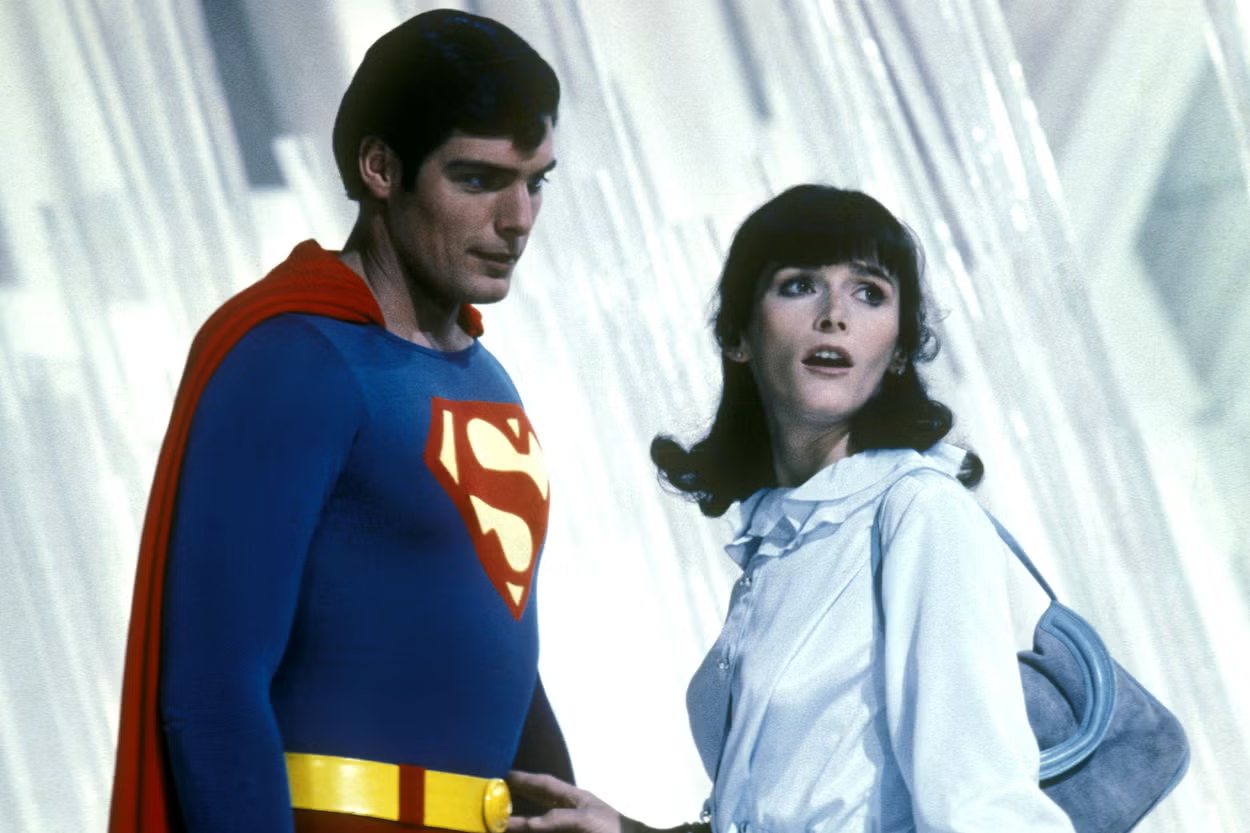
I mentioned in my review of The People’s Joker that when I was watching the film for the first time it reminded me of my childhood connection to Superman. I’d forgotten about it, but now I can vividly remember being in my childhood bedroom when I was five years old and waking up from a dream and feeling warm and fuzzy because Christopher Reeve’s Superman had hugged me and held my hand. I didn’t really know quite what it meant, but I remember feeling that I wanted to be what Lois Lane was to Superman. I thought you captured that so well in the Nicole Kidman scene in the cinema in The People’s Joker. It was about that really deep connection and finding yourself through these superhero and comic book characters, which is powerful, even tough they aren’t explicitly LGBTQ-identifying characters.
“Superman was created by two immigrant Jews who really felt the weight of the time period they were living in. It’s kind of like that Disney thing too, where there’s a queerness to a lot of those movies because so many people working on them were deeply closeted. I think about Wendy Carlos all the time too, about how trans her music is and how for most of her career she wasn’t out.”
“There’s such magic there too because on the surface these characters are just fantasy, colorful cartoon characters, but the humanity of the creators and the things that they’re actually trying to talk about—even if it’s coming from somebody who isn’t from a marginalized community—is always coming from this place of alienation and wanting that connection that you’re describing. I really wasn’t that aware of it while we were making it in any way, other than intuitively following the creative bread crumbs in the story’s form telling me what it was as it was happening and refalling in love with these characters.”
“Speaking of Clark and Lois, we have them in the film. They’re news anchors on a show called Progressive Wow. I think a lot of people would assume that I grew up in a house where there was a lot of Alex Jones playing, but that was actually later in life. That was a choice I made in college because he was the only person at the time talking about police brutality and how George Bush was a war criminal and that we should be civilly disobedient, and now he’s the worst person ever. I actually grew up watching a lot of MSNBC and I was really obsessed with queer representation in news and things like Democracy Now and Rachel Maddow. We totally ripped off Rachel Maddow’s glasses for he/him lesbian Clark Kent. That was something I arrived at because we wrote a little bit of a backstory for those characters.”
“Every single character in the movie has their own arc that I fleshed out either with the people who were playing them or with Bri or just on my own. The Riddler has his own too. In fact, there’s a Riddler movie happening within The People’s Joker, if you just really watch Riddler’s scenes and that’s because Trevor Drinkwater who plays him essentially wrote “The People’s Riddler”. I don’t know that he’s ever going to do anything with it, but I told him, ‘If you ever want to, go for it, but I can’t help you’. I’m done playing in this sandbox for now!”

“I was obsessed with the idea of Clark and Lois as these characters that are maybe embodying some sort of facade from the best place. I mean, if they’re two queer people—I’m coding them as lesbian co-anchors of a progressive morning talk show—then they’re not trying to embody the state and further militarize the police force, even though that’s what their show’s doing. They’re just trying to be a part of queer representation. That’s happening with those characters and maybe somewhere in the movie one of them realizes, ‘Oh, I’ve got to break out of this’. There’s a movie happening with them too in the background if you really watch it.”
“With all of these characters, it’s really kind of all the same story, and it is a queer story. I thought it was a specifically American queer story with the pressures of living in a country where we’re told that 50% of the country hates you and 50% is on your side. For me, it’s so blurry about what that means now because it feels more like one side wants to be us or something, but is scared of that, and then the other side is letting them imprison us in the wrong prisons and taking our rights away.”

“Everybody is kind of complicit in the absolute exploitation of our own community. Me, right now, by entering the economy with this film there is a little bit of guilt that I feel because I’ve met so many other filmmakers this year who have made movies like mine that come from that place of real honesty and a community mindset that the people reading this will never hear about. It’s weird to think about how The People’s Joker will be commodified by somebody else and be twisted to fit people’s agendas, but it’s kind of designed to do that. It’s a movie about identity and myth and exploring it through these characters, but it’s also about how these characters kind of are propaganda. I made a piece of propaganda and it’s not woke propaganda.”
“I get called transphobic once a week online, which is funny. I have been called alt-right adjacent, which I think is just because I say the slurs that I was called. I was on Tumblr, so I am toxic just like everybody else. There’s a thin line between incels and trans women at times and that is the sort of propaganda that I think The People’s Joker is really about and it’s why I’m glad that cis people are connecting with it because we’re all at this place of coming of age in this world of a lot of inauthenticity. It’s really scary. Everybody’s struggling for identity.”

“Why are young men flocking to people like Jordan Peterson or even Joe Rogan? They need a sense of identity. We’re so gender focused now, not just trans, but expectations of what men and women and everything in between are supposed to be. I say all that because sometimes I’ve seen people call the movie “The Woker”, and I’m like, the movie is as woke as an F-slur. There’s a character in it that is a cop who kills himself at the first sign of trouble. There are jokes in it that are offensive. Conservatives could actually appreciate some of the stuff that’s in the movie is basically what I’m saying. I don’t need them to like it, but I would encourage them to give it a chance. Especially if they like Batman, especially if they’ve had an experience like you’ve described and that I’ve had with Nicole Kidman, where these characters actually do mean something to me on a religious level.”
“It’s fine, you can laugh at it. A lot of people treat it like it is a Neil Breen movie. Literally just a few minutes before we started doing this interview I saw Tommy Wiseau getting out of an elevator, which is funny because when I got to TIFF I walked into an elevator and Werner Hertzog was in it. I met Grant Morrison and John Cameron Mitchell this year too. Over the last four years as I’ve been making this, I’ve been seeing all these artists that I’ve really resonated with and it feels like they were also telling some version of this story.”

Last question, what’s your favorite piece of LGBTQ+ culture, or a person who identifies as LGBTQ+; someone or something that’s had an impact on you and resonated with you?
“John Waters kind of carried me into my transition. John Cameron Mitchell’s Hedwig and the Angry Inch was the final egg crack for me. My first time watching it, I was sad at the end that Hedwig takes off all of their clothes and is now their own gender. I was like, ‘Oh, but you were such a pretty girl’. Then I had this realization that that’s not what that movie is. I was like, you’re a dirtbag trans woman, that’s why you’re identifying with Hedwig, but this is not your story.”

“I was always into Kenneth Anger and John Waters, but kind of passively. Then I started exploring and watching queer film in a serious way. I was coming into my queerness and not feeling represented by the stuff that was being made at the time. I did not see anybody like me in movies or anything about our people and then I started watching every single John Waters movie. Up until that point, I had only seen Hairspray, Pink Flamingos, and Cecil B. Demented. Cecil B. Demented was actually the first John Waters movie that I saw and it was when I was a freshman in college. I wasn’t sure if I loved it or if I thought it was repulsive and really contrived, but that’s the brilliance of that movie and we kind of steal that a little bit in The People’s Joker by being both pretentious as a comedy movie and saying ‘comedy is very pretentious, isn’t it?’ Cecil B. Demented really asserts itself in that way.”

“I tore through every single one of John Waters’ movies in the span of three days, which I don’t recommend. It was like doing too many whippets, I think I lost brain cells, but I might have needed to lose those brain cells because I saw myself in those characters and particularly in Desperate Living. The People’s Joker wouldn’t be what it is without Desperate Living. Of all of his movies, it’s the one where when it’s over I feel like I need more, like I didn’t get enough, like I want to go back into that world because it’s like a fairy tale. It throws you right into the middle of this typical suburban setting, but it’s so dark and angry.”

“Oh, my God Mink Stole! I really hope I can, at the very least, meet her someday because she’s incredible in that film. She is playing one of the most hateful, worst people of all time, but that’s your avatar into this weird queer fairy tale. It’s funny because when they finally get to the town of Mortville all the aesthetics of it are how trans people dress now. It’s snakeskin, it’s every color under the sun. They all look like sexy Greenwich Village trans people. It’s like going to Bushwick. I felt so represented by Desperate Living. It is abrasive, but it forces you to meet these people on their level. It’s like, ‘No, they’re beautiful just like you’. I love any queer fairytale and that’s my favorite of his films.”

“A Dirty Shame is so underrated. I wish I lived in the timeline where that movie fucking made like Old School or Hangover box office numbers and we had an era of disgusting filth like that. I’m obsessed with Tracey Ullman. Her are arc on the most recent season of Curb Your Enthusiasm is amazing. Speaking of disgusting people, her character is repulsive, and she’s so good in it.”

“I love you John Waters. I consider you almost like a father. I’m sorry, but it’s true. Thank you for carrying me into my transition and really encouraging me to be a dirtbag in a time where I was surrounded by really soft, tender queers, who were encouraging me to watch really bland things that I didn’t feel reflected in. I feel reflected in your art even when I watch it today. I’m so excited to see your new movie. I worked with Aubrey Plaza once on a Roman Coppola movie. I doubt she remembers me, but tell her I said ‘Hi!'”
By James Kleinmann
The People’s Joker is now playing at New York’s IFC Center and Nitehawk Williamsburg, Los Angeles’ Landmark’s Nuart Theatre, as well as in other cities, and continues to rollout across the United States and Canada with select opening weekend Q&As. Complete theatrical listings can be found at alteredinnocence.net/thepeoplesjoker and ThePeoplesJoker.com.
Follow Vera Drew on X @VeraDrew22 and on Instagram @VeraDrew22.
