

Following its world premiere at Cannes, where it was nominated for the Queer Palm and won the Critics’ Week Grand Prize, writer-director Ratchapoom Boonbunchachoke’s startlingly original and delectably queer debut feature A Useful Ghost (Pee Chai Dai Ka) made its North American premiere at the 50th Toronto International Film Festival. It went on to be selected as Thailand’s official entry for Best International Feature Film at the 98th Academy Awards.

Inspired by a Thai legend, the genre-dying, absurdly hilarious and arresting film follows March (Wisarut Himmarat) as he is mourning for his wife Nat (Davika Hoorne) who recently passed away due to dust pollution. Ironically, she returns to him in the form a possessed vacuum cleaner, but their enduring love is rejected by March’s stern mother, Suman (Apasiri Nitibhon), along with her disapproving in-laws. That is until Nat proves herself useful in exorcising the family factory from the unwanted spirits who have shut the building down.

In the world of the film, ghosts can only appear in the human realm as long as they are remembered by the living. Therefore in order to rid the factory of ghosts, the living are subjected to a form of electroconvulsive therapy to make them forget their loved ones. Meanwhile a government minister, Dr. Paul (Gandhi Wasuvitchayagit), is determined that the memory of certain historical events, such as the real-life deadly 2010 military crackdown on protesters, be similarly forgotten. The film’s central narrative is framed by a young queer man, a self-described “Academic Ladyboy” (Wisarut Homhuan), who finds himself owning another possessed vacuum cleaner and subsequently receives a visit from a handsome and mysterious repairman (Wanlop Rungkumjad) with a story to tell.

Boonbunchachoke’s acclaimed 2020 short film, Red Aninsri; Or, Tiptoeing on the Still Trembling Berlin Wall (Aninsri daeng) about a transgender sex worker assigned an undercover spy mission, won the Cinema and Gioventù Leopards of Tomorrow Jury Prize at the Locarno Film Festival. Of Teo-chew-Hainanese descent, the filmmaker was born and raised in Bangkok, where he teaches film theory and screenwriting alongside his filmmaking career.

Ahead of the US theatrical release of A Useful Ghost this Friday, January 16th, Ratchapoom Boonbunchachoke speaks exclusively with The Queer Review’s editor James Kleinmann about the draw of filmmaking as a storytelling form, the inherent queerness he sees in the film’s originating legend, his approach to its visual style, and his admiration for queer German filmmaker Werner Schroeter.

James Kleinmann, The Queer Review: what was the draw for you of film as storytelling medium?
Ratchapoom Boonbunchachoke: “I have always been so fascinated with storytelling. When I was young, I wanted to write stories for role-playing video games. I used to love playing the Japanese game Final Fantasy, which was such a huge hit in Thailand when I was growing up. When I finished playing a game, I would retell the whole story of what I’d just played to my parents before I went to bed. So instead of the parents telling a story to the child, it was a reversal of that, and it was me telling my game story to my parents.”
“Later, I wanted to be a novelist and asked my mother how I could become a writer. She told me that writers are really knowledgeable and that they read a lot. So I thought I should start reading and I educated myself about the kind of topics writers write about, what kind of techniques they use, what kind of language, and how they craft their prose beautifully or poetically.”
“When I was in high school, I would read a book a day or every two days. Then I started watching films as well because I was drawn to them as another storytelling medium. I also realized that I could finish more films in a day than books. I could watch three or four films in one day and I often did. I became so fascinated with film and my focus shifted to wanting to become a filmmaker. I like telling weird stories and it struck me how weirdness can be conveyed through storytelling. Something that you don’t see in your everyday life somehow sounds so logical in a story, whether it’s in a book or in a film.”
There are a lot of delicous flavours to this film, but at the heart of A Useful Ghost there’s a romantic and tender unconventional love story between a living man and his recently diseased wife who possesses a vacuum cleaner so that they can be together. Do you see a queer aspect to that relationship?
“In Thailand, we have a lot of legends about the romantic relationship between a human and non-human, whether it’s a ghost wife, a serpent that can transform into a human, or the spirit of a tree that’s personified as a human. The legend that A Useful Ghost was inspired by is Mae Nak about a female ghost and her living husband. I couldn’t believe that this story existed in 19th Century Thailand. In all of the various legends about a human and non-human trying to be together, somehow at the end society won’t allow them to be. I always found that forbidden relationship resembles what LGBTQ people might have faced throughout history, whether it’s a man who wants to love another man or a woman who wants to be in a relationship with another woman, they face obstacles from a society that’s not happy with their relationship. I’ve always found this forbidden human-ghost relationship to be queer in that sense. There’s definitely a queer aspect to it.”

“Thailand is known for being quite an LGBTQ-friendly country, but there is also some discrimination. For example, it’s kind of a huge thing here that if you are the parents of a queer child then you might say to them, ‘Oh, it’s okay, you can be gay or lesbian as long as you are good, as long as you are a decent person contributing to society.’ I find that conditional love or conditional acceptance quite intriguing. The idea that you can be loved or accepted only as long as you are productive or produce something useful. It’s the same thing with the analogy of ghosts in the film, that they can be accepted if they stop being scary and try to be useful or productive and contribute something. That was the perspective from which this whole story started for me.”
March mentions to Nat that his gay brother was being threatened with conversion therapy when he came out and that he was only accepted when he started to make a profit for the family business.
“Yeah, gays who make money are seen as acceptable.”

I love how you populate the film with queer characters, including two who frame the main narrative. What was your approach to bringing in such a variety of characters who aren’t necessarily defined by their queerness and who are certainly much more than their queer identity?
“I wanted to bring many dimensions of queer characters into the film. In Thailand, we have had a lot of romantic comedies or romantic dramas about two beautiful boys falling in love with each other. I feel like queer and gay characters are confined to certain genres in Thai film. They only exist in these romantic dramas or comedies, and within those films they don’t do anything except falling in love and seducing or chasing each other.”
“As a filmmaker, I don’t think I’m good at making romantic films anyway, but in any case I wanted to see queer characters doing something else. I want to see queer characters in other genres. Essentially, I want to make the kind of films that I want to make first of all and then put queer characters in them in a way that the film industry doesn’t expect. The film itself comes before sexuality. I want to make films where the main characters happen to be queer. I want to make a thriller, but make it queer. I want to see the film populated by queer characters but I don’t necessarily want to underline or highlight them as queer characters, but in this universe, in the world of this film, a lot of people are queer in one way or another.”

The first character we meet refers to himself as an “Academic Ladyboy” and that’s how he is named in the credits. Can you give us an insight into why he calls himself that? Is there an aspect of reclaiming that word in a similar way to the use of “faggot” in the United States?
“It’s quite tricky to translate the term because in Thai we would say “Kathoey”. It’s an old term which used to be offensive sounding and then in the last decade or so it has been reclaimed, people started to describe themselves as Kathoey. It’s a wide umbrella term that encompass a lot. It could refer to cis gay men as well as trans women. The word faggot might be an equivalent in some ways, but we didn’t use that word as a translation because it might be a bit offensive to some people.”
“I’m not sure how the word ladyboy originated, but it’s how trans women in Thailand identify themselves in English to foreigners. So its use in the film might be a bit confusing for international audiences as they might think that he doesn’t look like a ladyboy. But I think some Kathoey in Thailand would say that it’s not about gender or sexuality and it’s more like a lifestyle. You can behave like Kathoey without having to be trans or gay. Another English term that might fit would be queen, as in ‘you’re so sassy queen!’ Even in the Thai language, the character’s description of himself as an “academic ladyboy” sounds funny. It doesn’t sound natural at all. It’s such a weird composite, putting those two words together.”

What was your approach to creating the striking visual language of the film?
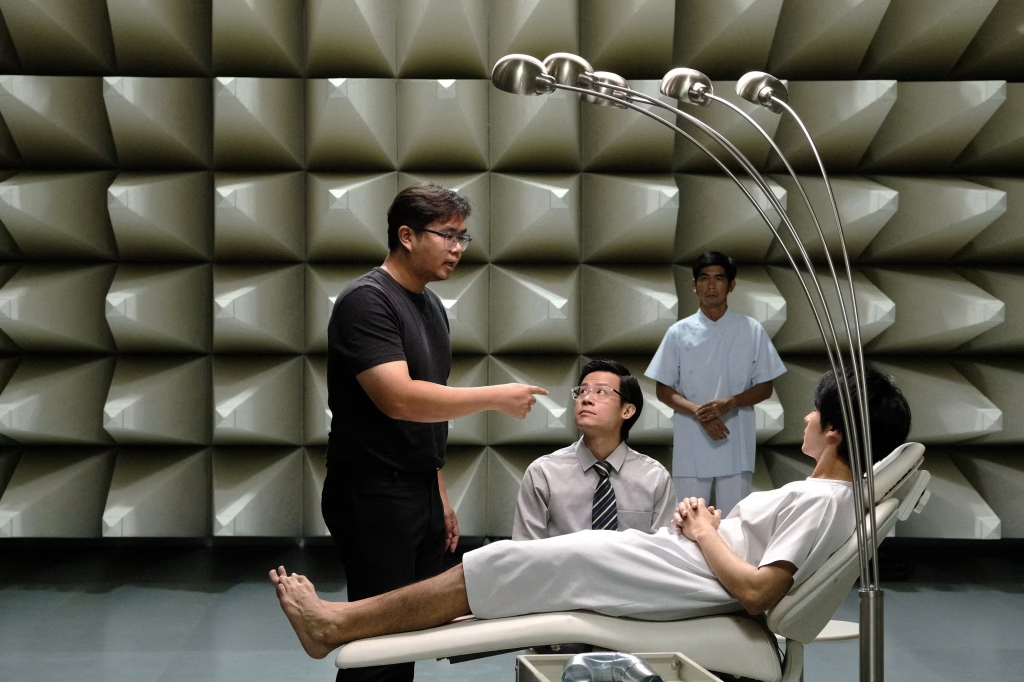
“When I was preparing to make the film, the guidance that I gave to my team is that I wanted it to look elegantly perverted and perversely elegant. It should look so beautiful and also contain something so naughty or so perverted because the story itself contains a lot of ridiculous situations. There’s a lot of silliness in it, but at the same time I want the film to be taken seriously and so I wanted it to look meticulously composed. I knew that it needed to be constructed very deliberately. I wanted it to look like we had put so much energy and attention into how we crafted the visual design, then juxtapose that with dialogue and situations which are so ridiculous. I like this contrast because I don’t think people would expect that these two things could be in the same film, but that’s what I tried to achieve. That the high and low, the silly and the serious, coexist in one film.”

That approach comes into the stylized acting style too doesn’t it?
“Yeah, they’re composed but they’re saying something so silly.”
What did it mean to you that the film was selected as Thailand’s official Oscar entry for the International Feature Film category?
“I feel so honored. I never expected that our film would be chosen because it doesn’t fit the expected criteria of an Oscar film, but I feel so proud that it was selected.”

Lastly, what’s your favorite piece of LGBTQ+ culture or a person who identifies as LGBTQ+; someone or something that’s had an impact on you and resonated with you?
“The first person who comes to mind is the German director Werner Schroeter, who was a contemporary of Rainer Werner Fassbinder but is less well-known. In my last year at high school, the film club that I was part of borrowed a copy of his 1991 film Malina from the Goethe-Institut so we could screen it. It stars Isabelle Huppert and the film is so crazy. It’s so operatic and melodramatic; it’s insane. It’s full of emotion and no reason at all. Until I saw it, I hadn’t realized that you could make a film like that. I was so young when I first saw it and it’s a film that really impacted me. It really affected me in my formative years and opened my eyes to how a film could be. Schroeter’s work was very influential on me.”
By James Kleinmann
A Useful Ghost opens in select theaters on Friday, January 16th 2026, including New York’s IFC Center.

Leave a Reply