

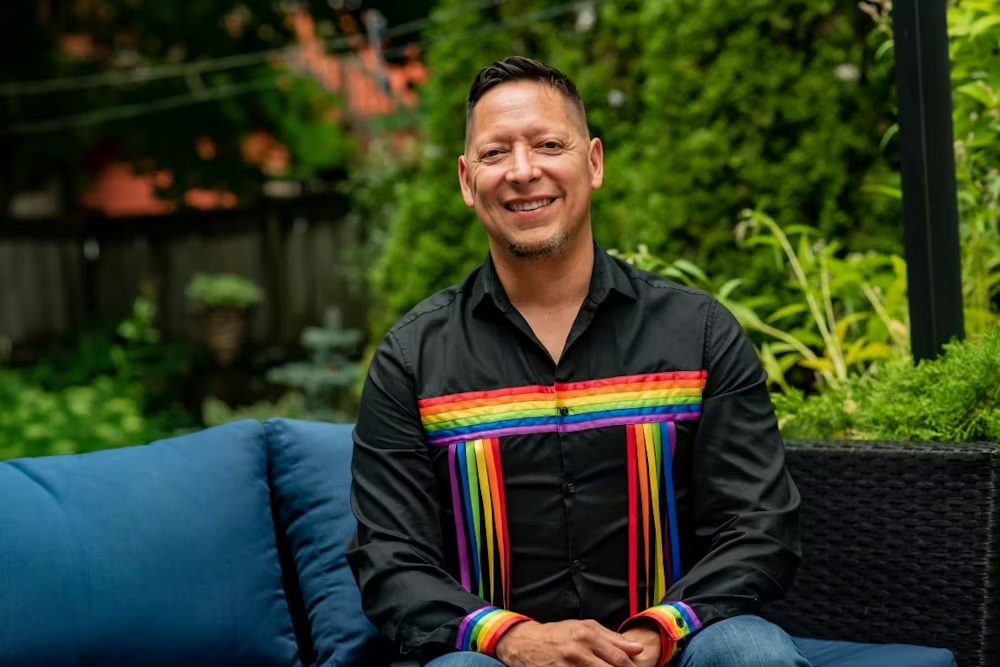
Bretten Hannam is a Two-Spirit L’nu filmmaker living in Kespukwitk, Mi’kma’ki (Nova Scotia), Canada where they were raised. They wrote and directed the short films, New Skin, Puppy, Deep End, and Elmiteskuatl, and the features North Mountain and Wildhood, which was one of the 2SLGBTQ+ highlights at the 2021 Toronto International Film Festival (TIFF). Hannam returned to TIFF for its 50th anniversary edition for the world premiere of their latest haunting and deeply poignant feature Skɨte’kmujue’katik (At the Place of Ghosts) which saw the writer-director reunite with Wildhood cinematographer Guy Godfree with breathtaking results.

The family drama with thriller and supernatural elements follows siblings Mise’l (Blake Alec Miranda) and Antle (Forrest Goodluck)—offering affecting, nuanced performances—who were close growing up but have drifted apart as adults. When a malevolent spirit begins tormenting them, they are forced to reunite and journey into a primordial forest that exists outside of time, to confront their violent upbringing. Sk+te’kmujue’katik (At the Place of Ghosts), which made its international premiere at the BFI London Film Festival and went on to play NewFest: New York’s LGBTQIA+ Film Festival, screens at TIFF Lightbox, Toronto as part of the Canada’s Top Ten series on Friday, February 6th, 2026 at 6:30pm with filmmaker Bretten Hannam in attendance for a post-screening Q&A.

Following the TIFF world premiere of Skɨte’kmujue’katik (At the Place of Ghosts), Bretten Hannam spoke exclusively with The Queer Review’s editor James Kleinmann in Toronto about the extensive screenwriting process, the personal importance of reflecting their culture and language on screen and creating opportunities in the film industry for their community, casting and working with their two lead actors, and their admiration for Wabanaki Two-Spirit Alliance co-founder John Sylliboy.

James Kleinmann, The Queer Review: as you introduced the film at its TIFF world premiere, you said that it had shaped you as much as you had shaped it. I’d love it if you could expand on what you meant by that.
Bretten Hannam: “It’s taken over 11 years for this particular project to happen. About nine or 10 years of that was mostly me spending time with the story. I won’t say it was all on my own because I was discussing the story and the film that I wanted to make with family and friends and community, getting their feedback and hearing their feelings on it. This film deals with connection to the land, connection to community, connection to family, and intergenerational trauma. As I was writing, all those things that echoed in me were drawn out.”
“The very first thing that I wrote was the pivotal scene set in the orchard with the father and the two siblings. As I was writing that, I felt all the things that the characters are going through; these really harrowing, violent, traumatic experiences that are rooted in colonialism and homophobia. It’s terrible and there’s this really heavy weight that I have to process emotionally. I have to deal with it myself before I give the script to an actor or to anyone else. It’s something that lives in me and so it shapes me and I respond to it. I’m like, ‘I can’t live with this. This will kill me. To hold this in would kill anyone.’ That becomes the impetus for me to get it out. I need the story to unfold because it has to go somewhere.”
“As I’m feeling all these emotions and trying to process them, that’s when the story begins to speak to me and says, ‘then this happens’ and ‘what if this happens next?’ Then I’m able to follow these threads or streams in different ways. I’m like, Okay, the characters grow up with this trauma and they hold this. They’re estranged and they’re apart and it’s painful. Then they come together again and there’s still pain and they don’t know how to relate because they’re different people now. They’re not those kids anymore, but on some level they still are and then they meet those kids. How do I feel about that? As all of this opens up, I’m like, ‘Holy shit!’ I begin to respond to it and it shapes me and hopefully makes me a better person. I don’t know. It’s a process.”

As you mentioned, it’s a film about trauma—personal trauma and generational—but also of healing as well.
“I don’t believe it when people say that something is broken beyond repair. That the damage is too great. That your only experience is trauma. You’re damaged forever. You’re damaged goods. That idea is quite prevalent. One can feel like that sometimes and that’s totally valid, but I don’t think that’s the end. We continue, we progress. We hold on to those pains, like thorns inside, but there comes a point where they need to be pulled out. You can excise them.”
“Sometimes scars need to be reopened to get to the root of them to clean them out so that the things that are broken, feeling damaged, can be repaired and healed. It may change totally your nature or the nature of whatever is being healed, but that doesn’t mean that it’s it’s gone, it’s just a new thing. It’s hard work. Healing sucks because it hurts so much. Sometimes it hurts worse than the initial pain inflicted.”
“People like to throw around the word healing casually. Like, ‘Oh, I’m focused on my healing and self-care.’ That’s great, it’s important, but the reality is that it’s gritty and dark and raw and visceral sometimes, but it’s necessary. What’s the alternative? To continue to live in fear and pain. Sometimes it’s difficult and you can’t do it on your own. In this particular case, in the movie, it’s about the two siblings together. If it was just one, they couldn’t do it, but in coming together they manage this feat of healing.”

The father is a sinister presence at the beginning of the film and as we see what happened in the past he comes to feel like the personification of homophobia, rooted in colonialism.
“Yes, I would say that’s a legacy of colonialism. Two-Spirit is an umbrella term, it’s a placeholder because every nation has their own language and their own roles for what would be Two-Spirit people. We’ve always been here. We’ve existed before, we continue to exist, and will exist in the future. We’re not going anywhere. It’s only attitudes and perspectives of oppression and rejection that come along and create disruptions. That’s part of this story. It’s the seed of one of many things that’s taken root in the heart of the father of these siblings. He has his own damage. He has his own complicated story but we don’t explore that because we don’t have time to explore everything in the film. He’s in a place of fear and of hurt. He’s lost himself and he can’t see his child, he can’t accept who they are. That is the thing that he passes on to them and it’s a sickness that eats them from the inside, which is a pretty visual metaphor in the movie.”

How important is it to you to reflect your culture and language on screen?
“It’s one of the main reasons that I do anything. To give something back to the community. Obviously we have young actors in this film and we have more and more people in front of the camera and behind the camera as things grow. So it’s about giving back to the community in terms of training and mentoring in filmmaking but also about clearing a way to say to others, ‘you could also do this, you can use your voice to speak up for your story, your family, and your community.’ These are important things. I see it as saving a place for the next generation, for the generation that comes after that, and then so on. After the third generation, no one will watch my films anymore! But I’m always thinking more about community than anything else. I’m trying to be responsible. I’m trying to do good things for my community, for my nation, for my culture, so that they can be heard even more. But if they ever tell me to shut up, I’ll shut up!”

Your two leads, Blake Alec Miranda as Mise’l and Forrest Goodluck as Antle, are both wonderful in the film. How would you describe your collaboration with them? Most of the time it is just the two of them on screen isn’t it?
“Yes, that was actually probably one of the hardest aspects of making this. It’s like when you have a film where one character is in every single scene, here we have two characters who are pretty much in every single scene. There are only one or two scenes at the beginning and around the middle where they have separate moments. Because they are together so much in the film the actors weren’t cast individually, it was all about how they interacted with each other.”
“The actors spent time together outside of being on set, deepening their relationship. As a director I was thinking about what I could do to provoke this relationship a little bit more. On the day, I’d watch what they were doing in the scenes and I’d reposition them and do what directors do to mess around with stuff then step back and hope that it all came together. I was amazed by what they achieved because these are not only very emotionally vulnerable roles but they’re also very physically demanding. We were tossing them in rivers and going through the woods so they were wet and dirty and sore. There were bugs everywhere. I was so impressed by how they handled everything and the performances they gave. I loved working with them.”

A lot of your shooting locations were out in the forest. In the film, the forest speaks to the characters and gives them guidance. Did you feel that in certain locations as you were making the film?
“Yeah, definitely. It’s the same idea as in the story. When you do a location scout, you’re like, ‘this is a place that works and it looks really nice’, but then when you show up on the day and you’re outside, you’re on the land, you’re in nature, it very seldom does what you want it to do. It’s just going to do what it does. Maybe a badger has moved in since the location scouting or it’s going to rain. Anything can happen. So you have come to set in the middle of the woods and say, ‘what is it giving us today?’ Then you have to work with whatever that is. You can work against it, but you can only get so far before it kicks you in the shin!”

How would you describe your approach to creating the visual language of the film?
“I had the fortune of working with Guy Godfree as the cinematographer, who also shot my previous feature, Wildhood. When we were beginning to talk about Sk+te’kmujue’katik we discussed how different it would feel to Wildhood. The force is in that film too, but it’s more active in this story. We talked about the nature of the relationship that the camera has to the forest and to the actors and everything else. It’s all about relationships. Guy is super talented, has a great eye and is such a sensitive person. I find that it’s very easy to work with him. I can say, ‘let’s shoot something beautiful’ and then it’s just about being sensitive to what’s happening with the land or what’s going on in the periphery of a scene even. Being in tune with it and going for it. I always tell him that if he sees something that’s great, just shoot it, and not to wait for me because things can pass so quickly. I’m looking for these unexpected moments and so is Guy. Sometimes that makes for double unexpected moments which is great.”
Lastly, what’s your favourite piece of 2SLGBTQ+ culture, or a person who identifies as 2SLGBTQ+; someone or something that’s had an impact on you and resonated with you?
“My good friend John Sylliboy who is a constant confidant, companion, and inspiration. I don’t know how he manages to do all of the many things that he does, it’s so amazing to me. I think he may be able to time travel or there might be a clone of him somewhere! To hear him speak with such knowledge and clarity and certainty about our language, our culture, and Two-Spirit traditions and experiences, while being mindful of the needs of other people and their boundaries is incredible to me. It is something that I’m always in awe of. On top of all of that, he also has great fashion sense and style!”
By James Kleinmann
Sk+te’kmujue’katik (At the Place of Ghosts) world premiered at the 50th Toronto International Film Festival and went on to play the Atlantic International Film Festival, BFI London, and NewFest: New York’s LGBTQIA+ Film Festival.
Sk+te’kmujue’katik (At the Place of Ghosts) screens at TIFF Lightbox as part of the Canada’s Top Ten series on Friday, February 6th at 6:30pm with filmmaker Bretten Hannam in attendance for a post-screening Q&A.
Leave a Reply