

During the early months of the COVID-19 pandemic, New York filmmakers Meriem Bennani and Orian Barki collaborated with voice actors and composers to create 2 Lizards, a captivating surrealist eight-part animated series. Originally released on Bennani’s Instagram account, the episodes focused on two anthropomorphic lizard best friends as they experienced the isolation, uncertainty and yearning for connection of 2020 as events were unfolding, including the movement for social justice reform.
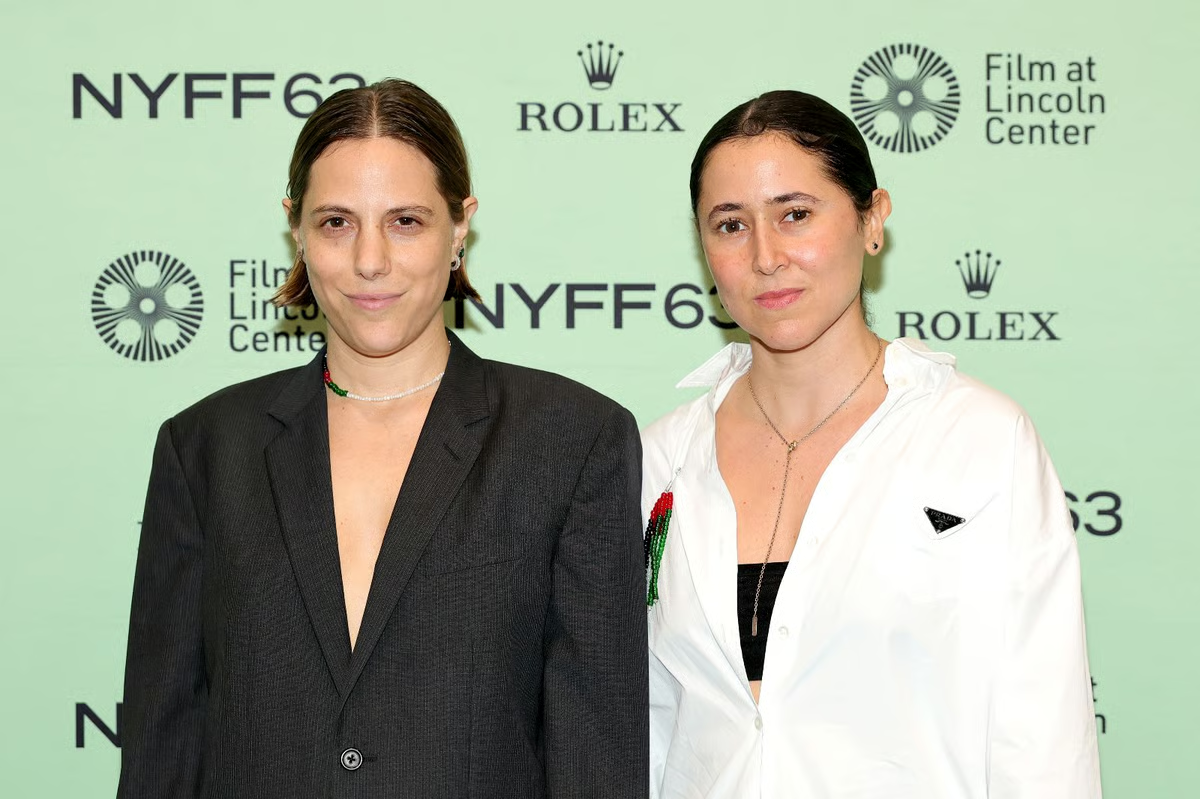
Bouchra, which received its world premiere at the 50th Toronto International Film Festival and went on to play the BFI London Film Festival and the New York Film Festival, marks Bennani and Barki’s debut feature collaboration. The film sees them continue to combine documentary techniques with 3D animation with startling results.
Brimming with raw honesty, humour, intimacy and tenderness, the film’s unconventional narrative structure follows a queer Moroccan coyote filmmaker, Bouchra (voiced by Bennani), living in New York who is preoccupied with how her sexuality has impacted her relationship with her cardiologist mother in Casablanca. Anxious to move on with her life and career, Bouchra is plagued by doubts and convinced that the only way forward is to use her art to confront the tensions and unresolved issues with her mother, whom she regularly speaks with by phone. These direct and intense calls are based on actual conversations that Bennani had with her own mother. Meanwhile, a “fictional” Bouchra visits her “fictional” mother, a celebrated painter, and their lively exchanges revolve around their mutual love of art, while the subject of Bouchra’s sexuality—which dominates the “real-life” conversations—is never broached.

Following the premiere of Bouchra, Meriem Bennani and Orian Barki spoke with The Queer Review’s editor James Kleinmann about the autobiographical elements of the film, shooting video footage to use as a guide for creating animated scenes, their approach to depicting sex, and the decision to use anthropomorphic animals.
James Kleinmann, The Queer Review: what were the origins of this film and how autobiographical is it?
Orian Barki: “The origins of this is our first collaboration, 2 Lizards. That’s when things really clicked between us. We’ve known each other for a long time and have always been a part of each other’s work, but we hadn’t collaborated on anything in earnest until that animated series. After we did that, we were like, ‘Okay, obviously we’re going to make another film together!’ We’ve always wanted to make a feature and Meriem got this opportunity through Fondazione Prada to do something big. So that’s how it came about logistically. In terms of the origins of the narrative, I’ll let Meriem tell you about that because it’s more of her story.”
Meriem Bennani: “Everyone says they want to make a feature, but it wasn’t just about the form for us. It was about exploring what happens if we had the chance to create a longer narrative, more space to tell a story and to spend more time with the characters and get to care more about them.”

I love how you let the film breathe. Like the opening, where we see the character throughout the summer. It’s really beautiful.
Meriem: “I’m glad you enjoyed it and as a fellow New Yorker I’m sure you recognized the Williamsburg Bridge.”
Orian: “Well, it’s a fictionalized Williamsburg Bridge.”
Meriem: “Yeah, everything is its fictional double in this film. Going back to the origins, I wanted to tell a story based on my relationship with my parents and my experience of moving from Morocco to New York. It’s a story that could be mishandled so easily. We had this impulse that talking about my queerness and being Moroccan with so much fear would be easy to get wrong. These kinds of stories are usually portrayed through a European or Western lens. It’s like, ‘look how hard it is for them to be gay while we live in these amazing democracies where there’s so much freedom.’ That perspective has been instrumentalized way too many times to justify political violence.”
“At the same time, there was a desire to make a film that the queer Moroccan community could claim and be excited about. When you’re doing something in a territory that is a bit new, it feels like there’s a responsibility to represent everyone, but if you try to do that you’re going to fail. In thinking about that we realized that specificity is the best tool. We really wanted to tell a story based on my relationship with my mom, while bringing in a lot of elements from our lives including our love lives, as well as bringing in our friends’ lives. The spine of the film are these phone calls that I’ve had with my mom about our relationship, so it was about building a story around that and always choosing nuance by having specificity and characters who are based on real people.”
Did you use real audio recordings of phone conversations with your mother in the film?
Meriem: “We recreated them with my voice and Yto Barrada, who’s an amazing Moroccan artist. She’s recreating my mom’s side of the conversations. We also fictionalized some things. We used those conversations as a narrative thread, then built a whole world around them.”

How would you describe the character of Bouchra and where she is in her life when we meet her in the film?
Meriem: “Bouchra is a 35-year-old filmmaker from Morocco who now lives in New York City. She’s struggling to write a film about her and her mom and because she’s struggling she calls her to try to understand her better.”
How did animation and using anthropomorphic creatures open up the storytelling for you?
Orian: “2 Lizards was the first time I’d worked with animation, whereas Meriem has a background in it and has always used animation and anthropomorphic animals as characters in her amazing art installations that include videos. Back when we were making 2 Lizards, I imagined what that series might have been like if the videos had been live action, just us filming ourselves acting. I was like, ‘Wow, why does that idea sound so cringe?’ I think working with animation and animals adds a surreal or abstract layer to these stories that makes them relatable.”
“People are always asking us, ‘why is it so relatable?’ I think that’s so cool because instead of just saying, ‘it’s so relatable’, they want to know why. The combination of real life, animation and anthropomorphic animals makes something interesting that we wanted to continue with this film. We also get reactions where people will tell us that midway through watching Bouchra they forgot that it was animated. Perhaps it’s because this is less DIY and more premium when it comes to the animation itself.”
Meriem: “I don’t think it’s because the quality of the animation is higher, it’s because it’s based on reality and the dialogue is so natural. We keep in the hesitations and the stutters. The dialogue hasn’t been written so it doesn’t feel scripted. We also go off script. A lot of it is just us taking a mic and improvising. There’s a scene where the main character, Bouchra, is with her best friend, Yani, and it’s just Orian and me with the mic going off, which we then edited. Both of us come from documentaries, but Orion specializes as a documentary filmmaker and editor, so we edit with this very raw feeling that comes through the animation layer.”

I think we have a strong emotional connection to animation and animals which this film really taps into. I grew up loving Nick Park’s Creature Comforts.
Meriem: “I love those too. As an artist, my very first animations were animals, I’ve always done them that way. If you deconstruct that instinct, there are big archetypes that we grew up with. There’s a bit of the history of the world in the instincts that I had as a late teenager because of the media that I grew up surrounded by. We all grew up with fables and animal based things like Disney movies and cartoons that were animal based. Using animals in my work eventually led to doing 2 Lizards and then Bouchra.”

What was your approach to depicting sex and the more intimate scenes?
Meriem: “We go for realistic. We filmed some friends actually making out. We had a storyboard of the scene and we directed them to fit with that and then we recreated it. The thing is, because they’re animals it’s never going to be completely realistic, but by having a video guide it helps to get the subtleties in the movement. Rather than coming up with a definition by going, ‘What does sex look like?’ If you have two people doing it in an improvised way they will do things that are not canonical to sex as we expect to see it on screen. They will do the weird in between things that make something specific. So we use documentary as a guide for the animation which gives us all these wonderful little glitches.”
Orian: “In the context of anthropomorphic animals and sex, obviously there’s a whole subculture with furries. So it wasn’t like we were doing something new. We were tapping into something that exists on many websites.”

The music is a really beautiful element of Bouchra, including an original song set in an elevator. What was your approach to that aspect of the film and are you afraid of elevators in real-life?
Meriem: “No, actually I have a rat phobia, which is unfortunate as someone who lives in New York! As all the characters in the film are animals we couldn’t really do the rat phobia, it would’ve been weird. So we wanted to come up with something else that it’d suck to be scared of in New York and came up with elevators. The music is by Flavien Berger, an amazing French musician who also happens to also be my best friend. We met each other after high school and have always worked together. He’s made music to everything I’ve done including 2 Lizards, so this was very natural collaboration. He usually does more electronic music, but since the film is already made on a computer we wanted something warmer and more analogue. So Flavien really challenged himself for us and recorded actual saxophones and flutes and other wind instruments for the soundtrack.”
“The original song is Flavien with Zsela. She’s a friend too as well as being an amazing, super talented, timeless diva. Although she’s young, her voice has such depth and she’s such a great songwriter too. We knew that we wanted her voice to be in the film at some point.”
Orian: “She watched the movie and then wrote the lyrics for the song. At first we were going to use it as a moment where there’s a song playing in the movie, but then we decided that didn’t make sense, we wanted it to be the voice of somebody. So we created the elevator scene after hearing the song and decided to animate the elevator!”

Lastly, what’s your favourite piece of LGBTQ+ culture, or a person who identifies as LGBTQ+; someone or something that’s had an impact on you and resonated with you?
Meriem: “Both of us are huge fans of Leilah Weinraub’s cult movie, Shakedown.”
Orian: “It’s a documentary about an early 2000s Black lesbian party in LA with strippers and sexual freedom. It’s such a special film. It’s so impressionist and the way it’s able to capture that scene is amazing. I haven’t been to the party, but as a viewer it’s so touching and artistic and beautiful. It’s available to watch online, so look it up.”
Meriem: “There are so many subcultures of Raï music, which is pop music from Algeria, and recently I’ve been really obsessed with a particular subculture of Raï and a group of singers. I don’t know that they would identify as queer themselves, but they have all the elements to identify them as queer, maybe for lack of a different word. For me, they’re so meaningful because the way that they’re coded is not a Western idea of queerness. They don’t speak like every teenager anywhere in the world speaks today, like RuPaul’s Drag Race, because of globalization. They’re fabulous, they make amazing music and they’re queer in a way that is emerging from Algerian culture which is really important.”
By James Kleinmann
Orian Barki and Meriem Bennani’s Bouchra received its world premiere at the 50th Toronto International Film Festival and opens in New York at at Metrograph June 26th, 2026.
