

Sam Dunn and Tom Morello’s rousing and reflective documentary The Ballad of Judas Priest, which world premiered at the 76th Berlinale, compellingly chronicles the pioneering heavy metal band’s history from its inception in the UK in 1969, through to its induction into the Rock & Roll Hall of Fame in 2022. Featuring some electrifying archive footage of live performances and candid new interviews with band members and their contemporaries including Black Sabbath’s Ozzy Osbourne, the film is a loving tribute that celebrates Judas Priest’s vital place in shaping heavy metal and its continuing legacy.

One of the most fascinating strands of the film follows the professional and personal life of Judas Priest’s lead vocalist, the Metal God himself, Rob Halford. While Halford’s bandmates always knew that he was gay, he did not publicly come out until 1998 in an unplanned moment during an interview with MTV. Defying preconceptions about the band’s leather-clad alpha male dominated audience, the reaction from fans and the metal community was overwhelmingly positive and accepting. As both Halford’s 2020 memoir Confess and the new film both reference, over twenty years before that, Halford had penned the steamy track “Raw Deal” on Priest’s 1977 album Sin After Sin, which includes explicitly homoerotic lyrics conjuring man-on-man action in a Fire Island bar.

Following the film’s premiere in Berlin, Rob Halford spoke exclusively with The Queer Review’s editor James Kleinmann about why he entrusted Dunn and Morello to tell the band’s story, how advice from Andy Warhol at Studio 54 had made him want to wait to watch the finished film with fans, what it was like to have to conceal his sexuality for three decades, and how he had been “hiding in plain sight” in expressing himself both lyrically and with his Tom of Finland-inspired look.

James Kleinmann, The Queer Review: Great to meet you Rob. I also grew up in the West Midlands.
Rob Halford: “Fantastic. Great to meet a fellow West Midlands lad. Where do you live now?”
I’ve lived in New York for the last ten years.
“I’m jealous! I hate the word regret, it’s a horrible word, but before I became officially ball and chained to my old man, Thomas, one thing I always wanted to do is spend a year living in New York City because I love the place. Sometimes we were there for an extended time, three or four days or maybe a week, to do press. Sometimes we’ll base ourselves in New York to fly in and out to do shows. It’s such a great town. I’ve got many friends up and down the city. I can remember the feeling I had the first time I went to the Village in the 70s, it’s like Mecca for the gays. The gays go to the Village in New York or to Castro Street in San Francisco, because it’s filled with our history. That’s where a big part of our culture is from.”

“I always remember the first time I went to San Francisco. We stayed at the Holiday Inn on Fisherman’s Wharf. I was walking around the area and there were a bunch of newspaper machines. I saw The Advocate for sale in one of them, which cost a quarter in those days, but I didn’t have any change. So I accosted this woman asking her if she had any change but she walked away. I was standing there, asking everyone if they had any change like a homeless person—bless the homeless—and eventually I got a quarter and got my hands on The Advocate. I went up to my hotel room and read it from cover to cover. I devoured it. It was the Bible for us all back then.”

Before the Internet it was so precious to get your hands on a gay magazine wasn’t it?
“Oh, God yes! I always used to have a copy of the Damron travel guide with me in my bunk on the tour bus. As we were traveling on to the next city, I’d be reading about every truck stop, every adult bookstore, every park—all the cruisey stuff—and all the bars, hotels, and restaurants. It was a great book. I had that with me wherever I went in America to find out where all the gay places were. That’s what a lot of us had to do then, especially those of us that were still so deeply immersed in the in the closet that we couldn’t see each other. Those guides, those magazines, and those newspapers were really vital for us. They were like a living connection between each other as gay men.”

Let’s talk about the film, which I loved. Why did you trust Sam Dunn and Tom Morello with the story of Judas Priest?
“At the heart of it is their love of this band and their complete and utter understanding about the heavy metal world. The music is the driving force. They’re both really genuine fans of the band’s music and I think that’s very important. Whenever you’re making a documentary, you’re investing your skill, your time and energy, but you have to have—if you possibly can—a deeper connection to the work that you’re making. That’s what happened with Tom and Sam.”

“This thing about trusting people to do the best possible work is important because I knew that this was a once in a lifetime experience. This is the first officially endorsed Judas Priest documentary and we had to get it right. With these guys as co-directors, I knew I could walk away and not worry. Because I am an over-thinker—which is a horrible thing—but it comes from the love that I have for the work that I do. I overthink things because I want the best out of it. I felt reassured that I could leave those guys alone to do the job that they did so that I could watch the finished documentary for the first time with my fans, which is what I wanted to do. I wanted to wait and wait and wait.”

“I told Tom Morello that I’d chatted with Andy Warhol years ago when we went Studio 54 together. Andy said, ‘One of the most exciting things about art is waiting for it to happen and I agree because you don’t know what’s going to happen. So you think. You fantasize. You imagine. You go on trips. I hope it’s this. I hope it’s that. What if it’s this? What if it’s that? So the expectancy, the excitement about the art that you’re about to experience, is part of the pleasure that we get when we do take the experience in. That’s why I wanted to wait and experience it with all of those wonderful people who came to see it at the premiere here in Berlin last night.”

What was it like to feel that you couldn’t publicly come out for decades?
“It was extremely difficult. If you’re a gay person, first of all, it’s finding the strength to accept yourself because when I was growing up when it came to gay people all I heard and read about were these deviants, these horrible people that were the scourge of the Earth. We had so much hate piled on us, and let’s face it, some of it is still there. So it was like, yeah, I’m gonna stay in the closet. Why would I want to confront myself to that type of reaction? But accepting yourself is crucial. Saying, this is who I am and I can be no other way. This is it. It’s the Gaga thing, “I’m born this way”. So that was one thing, but then for me to take that and try to put it into this alpha male heterosexual world, as it was then, was a lot of pressure.”

“The music has always led me. It’s been the leading source of my life for as long as I’ve been alive and certainly as a professional musician for 56 years or more. That’s what drives me. But the fact that I was never able to step out of that and go to bars and go to clubs and be photographed here or there was part of the hiding that had to be done simply because the reaction back in the day would have been detrimental. There would have been so much pushback, there would have been so much rejection that I put that part of my life to the back of the queue.”

“I know sexual identity is really important, but it’s not the be-all and end-all of who you are as a person. You’re more than a gay person, there’s more to you than that. So my work, the art that I make, the music that I make, that’s the most important part of who I am. Having said that, if there wasn’t this part of me as a gay man, I doubt I would have been able to express myself as I’ve done with the image or with the messages in the songs. You can’t deny the fact that there is part of me in my sexual identity that’s gone into the music. How would Judas Priest have been if there was a straight guy doing that job? It’s like, can you imagine Queen if Freddie would have been straight?”

“That part of us, our gay identity, is in our work. We’re probably not totally aware of it, but it is there and thank God it’s there because I was able to use my music as a catalyst to get me through all of those years before I publicly came out. When I did publicly come out on MTV in 1998, the reaction was very much like, “Duh, we knew!’ Then it was an interesting thought and debate about, you’re assuming that all gay men dress up in leather and wear whips and chains and handcuffs. To me, the look was just a very important part of putting across that strong, powerful image that the band was searching for, which we didn’t have that for the longest time. So when Judas Priest became famous and there was a focus on me and the band, there was an assumption because I dressed that way, I was a gay man. I still don’t understand that even today. It seems such a strange point of view. You look a certain way, so you must be this way.”

“At the same time, I’m really proud of the Tom of Finland correlation of that leather look. I’m proud of that part of who we are in our culture—the leather part of the gay world—and of that type of look and feeling. I love how we as gay people can accept and express ourselves without being judgmental because, let’s face it, we’ve been judged. Even now as gay people we’re still constantly being judged. They took the Pride flag down at Stonewall. It makes you roll your eyes and take a deep breath and go, ‘Has anything really changed that much?’ But as we saw, love wins, the flag went back up and that’s great. I am still really in love with everything that we are about in the gay community.”
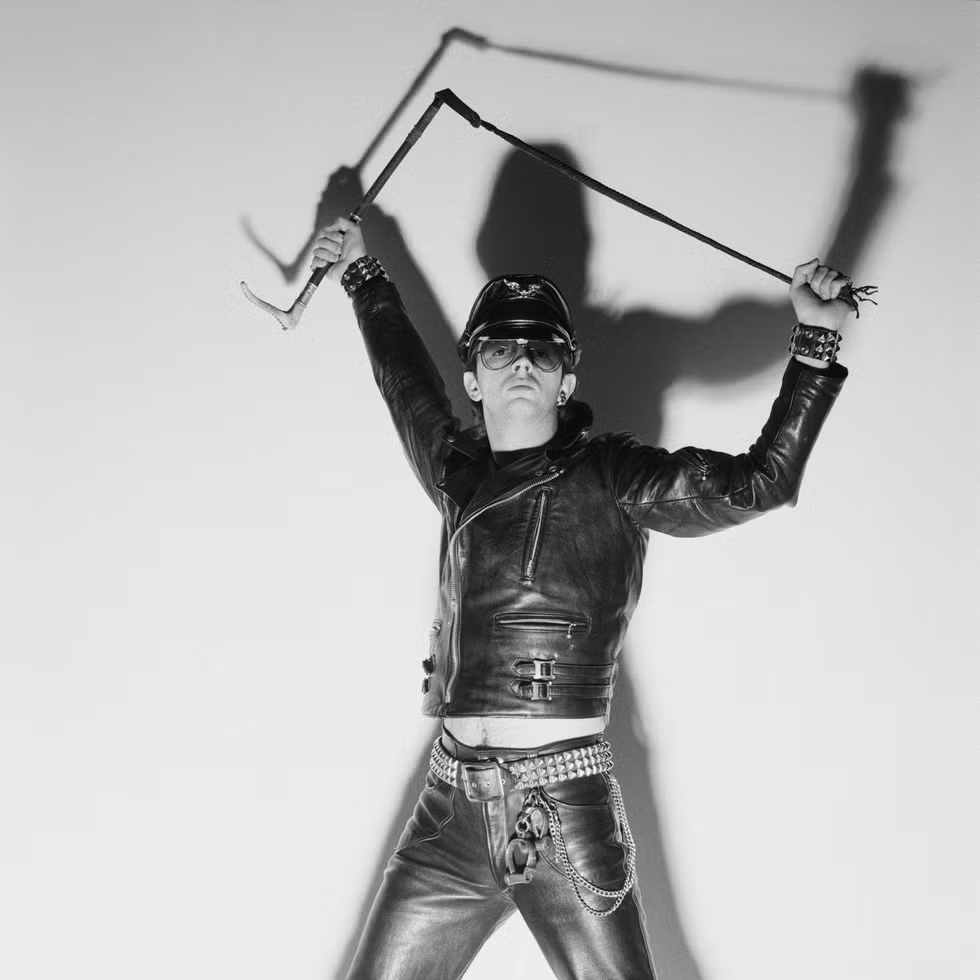
“The way that we express ourselves and the way that we are seen now in every household—whether it’s on RuPaul’s Drag Race, or it’s the hockey guys on Heated Rivalry, or whatever it might be—shows all of the different rainbow colors of the gay community. I’m so happy that’s now all at the forefront of who we are and that those on the outside looking in don’t just see us as one particular dynamic, they see us as many things. That’s really important.”

You mentioned the messaging in your songs. In terms of expressing yourself as a gay man, can we talk about “Raw Deal” on the 1977 album Sin After Sin?
“Looking back now, I still can’t believe it. It’s crazy. I was writing those lyrics in the studio in 1977 and the idea for the lyric came from that phrase at the end, “Love knoweth no laws”. I thought, how great is that statement? There are no laws in love. Love is love. Love doesn’t have any chains or anything binding it. There’s no law that controls love. Although, of course they have tried to put laws around our necks as gay men and said, ‘You can do this, but you can’t do that’.”
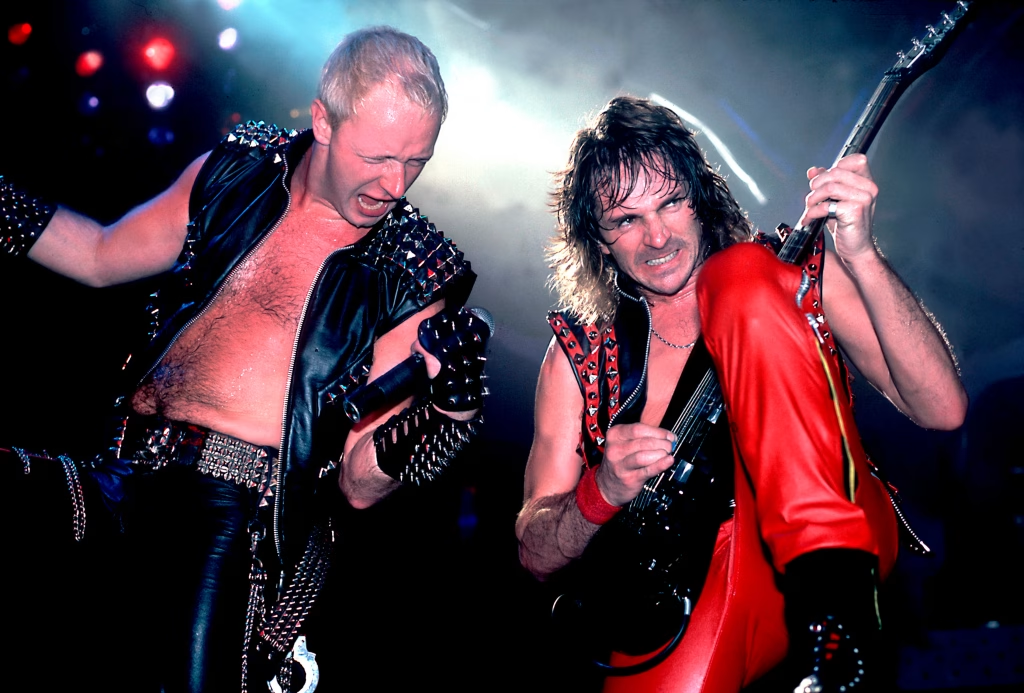
“That’s the joy of writing messages in music, these things just happen. They come to the forefront of your mind. I’d read something about Fire Island and the gay community there which I found really intriguing and so that then filtered through into the message. When I was writing it I was thinking about Colt because I’m a big Colt fan, so the lyric “a couple of Colts playing rough” came in and then the idea of “fooling with the denim dudes” came in and going into a bar and seeing all this cruising and stuff going on. I hadn’t been to Fire Island when I wrote the song and I’ve still never been. I’ve got to go sometime. I’ve never been to Provincetown either.”

“I finished writing “Raw Deal” and thought, this ain’t going to work. The guys are going go, ‘No, you can’t do this’. But this is the joy of being with these beautiful guys in Judas Priest; they didn’t even question it. They just heard the voice, the melodies, and the performance, and they said, ‘It’s great’. So that was my outing song in 1977 and I thought, I’ve done it. It’ll get picked up on. But nobody said anything about it. For the longest time it went over people’s heads. Then occasionally, later on, I’d get a journalist who would say, ‘What’s this “Raw Deal” song about?’ Then I’d be trying to walk around the block with my answer. But it’s a great song. It’s a really powerful moment, especially the breakdown section, where I’m talking about dreaming in pictures not colors. It’s a really good piece of work, with getting as much of the message across as you can and hiding in plain sight.”

Another lyric that really stands out to me in “Raw Deal” is “the true free expression I demand is human rights”.
“Wow. Now you bring that to the table. Why didn’t I remember that? Yeah, and the beautiful thing is that the guys accepted it. How great is that? These four alpha male straight guys just said, ‘Those are the words that we need, they’re the right for the song. It’s perfect.’ “Raw Deal” was my “Born This Way” in 1977.”
By James Kleinmann
The Ballad of Judas Priest received its world premiere at the 76th Berlinale. Watch a clip from the film below.
Enjoyed reading your great interview James with Judas Priest frontman Rob Halford and what brilliant photographs