

Unless you’ve been living in a BDSM dungeon for the past few months (no judgements here), you will no doubt have seen dreamboat daddy Alexander Skarsgård dominating red carpets around the globe with leather and fetish flourishes (“kinky in the front, kinkier in the back”, is how Vogue described his BFI London ensemble) since his latest film Pillion received its world premiere at the Cannes Film Festival. Set in present-day British suburbia, writer-director Harry Lighton’s stunning debut feature sees Skarsgård star as a mysterious gay biker, Ray, who takes on the unassuming and inexperienced Colin (Harry Melling) as his submissive, drawing him into an intoxicating Dom/sub relationship, that’s depicted with both authenticity and nuance. While Colin’s parents, Pete and Peggy (Douglas Hodge and Lesley Sharp), fully support their son being gay, they are thrown by the dynamics they observe between him and the devilishly handsome but impossible to read new man in his life.

As sweet and tender as it is sexy and seductive, with all the charm and humour of classic British movies like Beautiful Thing, Billy Elliot, and The Full Monty, without reliqunishing any of its queer edge, Lighton’s dom-com is a real winner. Awards bodies on both sides of the Atlantic are clearly in agreement, with Pillion up for three BAFTA Awards—Outstanding British Film of the Year, Outstanding Debut by a British Writer, Director, or Producer, and Best Adapted Screenplay—having already won the Un Certain Regard Screenplay Prize at Cannes, where the film was nominated for the Queer Palm. Pillion has also picked up trophies for Best British Independent Film at the BIFAs, Best Adapted Screenplay at the Gotham Awards, and British/Irish Film of the Year at the London Critics Circle Film Awards, among many other accolades.

All this acclaim has landed Lighton on Variety’s 10 Directors to Watch for 2026 list. Prior to Pillion, he made a raft of short films, including co-writing and directing the BAFTA-nominated Wren Boys which made its US premiere at Sundance. Alongside the British filmmaker’s own projects, he has worked with acclaimed Moffie and The History of Sound director Oliver Hermanus as a director’s assistant on the Oscar-nominated Living, second unit director on the Emmy-nominated series Mary & George, and as a writer on Hermanus’ upcoming Alexander McQueen biopic. The Oxford University graduate is a diehard fan of Brit girl groups like Little Mix and The Saturdays, and, as we learned in our interview with him, was once the lead singer of a Scissor Sisters cover band with his middle school classmates.

While the filmmaker was in New York this week, ahead of the US release of Pillion in select theaters from Friday, February 6th, we took him to one of Christopher’s Street’s longest-running and last remaining gay businesses, The Leather Man, to discuss the movie and try on some kit. Founded by Chuck Mueller, the store first opened its doors to leather lovers back in June, 1965, four years before the Stonewall uprising, and it continues to be the city’s go-to destination for the hottest S/M-leather-fetish clothing and gear.

In this exclusive conversation, Harry Lighton speaks with The Queer Review’s editor James Kleinmann about what enticed him to adapt Adam Mars-Jones’ novel, why he incorporated real members of the kink and gay biker communities in the film, what excited him about pairing Harry Melling and Alexander Skarsgård, his approach to depicting the Dom/sub sex scenes, and why he thinks British actress Miriam Margulies is the ultimate queer icon. With photography for The Queer Review by Mettie Ostrowski.
James Kleinmann, The Queer Review: Pillion feels like it’s a queer film for everybody, but without you having sacrificed any authenticity or making it “palatable” for a wider audience.
Harry Lighton: “That was always the idea. I didn’t want the film to feel at all sanitized, or that it wasn’t serving the community it represents, but I also wanted to upturn people’s expectations of what a BDSM film could be and that didn’t necessarily need to be relegated to an underground audience. So trying to balance the extremities of the sex and the Dom/sub relationship with mainstream elements from romantic comedies or Christmas movies, which are very familiar to a majority audience, was always my intention.”

Take me back to the first time you read Adam Mars-Jones’ 2020 novel, Box Hill: A Story of Low Self-Esteem, which your screenplay for Pillion is based on. How did you come by it and what was your reaction to it?
“I read it at the beginning of the pandemic when I was sent it by Eva Yates, the head of BBC Film. We’d been working on another film together which the pandemic got in the way of, so she asked me to take a look at Box Hill. It’s pretty short, it’s only about 70 pages. I feel like everyone always says that they read something in a gulp, but in this instance it’s true, I read it in about two hours. I was really struck by how complex the emotions it provoked in me were and how it did that within such a narrow frame of time. I would genuinely go from laughing to feeling turned on to feeling shocked or confronted in the space of five sentences. I thought that it was such an interesting tonal proposition to try to carry that across into a film. But I knew that it was going to be a challenge because it’s probably easier to demarcate shifts in tone in prose than it is in image. There’s also first-person narration which guides the reader through the novel, but I didn’t want to use voice-over in the film. So it was an intimidating challenge, but also an enticing one.”

The book is set in the 1970s, why did you want to bring your adaptation into the present day?
“I wanted to do that because with the 70s setting there was a lot of historical and sociopolitical context which made prejudice against any gay person at that time common. I thought it colored the relationship between Ray and Colin. It meant that there was an easy explanation for Ray’s anonymity, which was that he was worried about exposure. I was more interested in putting Ray in a time when—although there are obviously lots of people who are still closeted in Britain—it’s far less likely that a late 40s white guy is going to be closeted. It opened up more interesting questions for me about whether Ray was withholding information for erotic reasons as part of an erotic game and it allowed us to do something different with the parent characters.”
“In the novel, the parents are more consistent with parental attitudes of the 70s. Colin eventually comes out to his mum on Christmas Day and she says something like, ‘pass the Brussel sprouts’ in response, sweeping it under the carpet. Whereas with the film, I wanted the parents to be loudly wanting their son to find a boyfriend and then to withdraw that promotion of his sexuality when the guy he finds doesn’t meet their idea of what a partner should look or behave like. It certainly looks like they’re happy, but behave like it, not so much.”

One of my favorite scenes in the film is when Ray reluctantly agrees to have dinner with Colin’s parents at their home. It’s so beautifully orchestrated; funny, awkward, and moving. I felt like I was in the headspace of each of the four characters at various times. It’s a real mastercalss in screenwritng, acting, and direction.
“Thanks so much. It was definitely one of the biggest set pieces and the scene which I was the most nervous about going into the shoot because I knew it was the pivotal scene in terms of where that relationship goes next. It’s also the only substantial dialogue scene in the film. I knew that I wanted to put Ray and Colin’s relationship—which up until that point has been pretty cloistered within the gay biker community—into contact with people who, like Colin’s parents, have what could be called a more normative worldview. I wanted to have someone ask questions of Ray because Colin’s never going to do that, or if he does he’s going to do it in such a passive, quiet way. The idea that some matriarch would confront Ray and be like, ‘Actually, hold on a second, I’m not sure this is right for my son’ seemed delicious on the page and it ended up being a lot of fun to try out variations of that dynamic between Peggy and Ray in that scene.”
“Particularly for queer people, bringing your first boyfriend or girlfriend home does carry a different charge because your parents are often trying to work out how to adjust themselves to that situation. They don’t want to be offensive on the whole and I think that’s very true of Pete and Peggy. They don’t want to be considered homophobic or rude and they’re trying to work out how to play that dinner and Pete especially wouldn’t say boo to a goose. But then the mum essentially goes, ‘Actually, you know what? I don’t think I am being homophobic, I think you’re being a cunt!'”

That’s such a great moment, which had the audience howling at the screening I was at. How much did you know about Dominant/submissive (D/s) relationships within BDSM culture as you embarked on writing the screenplay and what kind of research did you do?
“I’d explored and knew about various aspects of domination and submission tangential to what I’d call a strict Dom/sub relationship, like the one depicted in the film, but I also did lots of research in the writing process particularly. I interviewed all sorts of couples in varying degrees of strictness because I wanted to have a really clear understanding for myself of the breadth of those relationships. Dom/sub relationships are very much not one-size-fits-all and I wanted to know what would be considered the most ethical way to practice that kind of relationship. Not so that I could then deviate from that with Colin and Ray, but so I could know what I was deviating from.”
“When we started shooting, we cast all the biker gang from the kink community and from the biker community. Some of the bikers in the film are from the Gay Bikers Motorcycle Club (gbmcc). It’s not a sex-related group, it’s a gay bike club in Britain, but there is obviously some crossover. They ended up being key resources both for me and for the actors. For instance, Harry asked one of them—Paul the pup—how to lick a boot. Paul got one of his friends who’s into boot licking to tell Harry the difference between a good boot lick and a bad boot lick. It was invaluable having their knowledge and insight when we were trying to calibrate someone like Colin’s lack of experience, or experience, as the film goes on.”

That care and attention to detail really shows in the film. Why did you cast Harry Melling as Colin and what excited you about pairing him with Alexander Skarsgård?
“Towards the end of writing, I knew that people were happy with the script and that we were going to look into getting it made, so I started thinking about who to cast. It was really fortuitous that I happened to watch a film called The Devil All the Time which Harry plays an evangelical preacher in. He sings in it too and I knew that I needed someone who could sing, but I also watched that performance really closely and there’s a moment in it where he is walking to his death essentially, thinking that he’s going to be shot. The expression on his face in that moment was exactly how I envisaged Colin walking to the alley to give Ray a blowjob. I was like, ‘Who is this guy?’ Because I didn’t recognize him from the Harry Potter films. Then I looked at all of his performances. Especially in The Ballad of Buster Scruggs—but really across the board—he was so watchable and so unique in his watchability. He completely commands the screen, but does so in a way which is so not alpha male and so interesting to me, which also felt kind of queer in that sense.”
“I wrote Harry a letter then crossed my fingers, and luckily he said, ‘Yes’. Then it was about finding someone who would be a visual match that would be interesting for Harry. Harry’s got such a photographic face and I knew that I needed someone else who was both obviously beautiful—because Ray needed to be the hottest man in the room—but also had a physicality which stood him apart from other people. Alex is a giant, so I knew that’d be great. I also knew that it would be boring if Ray was just some hunk. I needed someone with real psychological skill too because that’s part of the power game they’re playing.”
“I’m a Succession diehard and I’d been watching Alex in it as Lukas Matsson and loved the way that he dominated the Roy children in all of their scenes. I thought it was so interesting that he played against his looks by also being psychologically the most clever person in those rooms and trolling those children in a way which was quite playful and funny, but you can also see a Machiavellian quality there. I knew he’d be so captivating in this role and so interesting opposite Harry, so I wrote another letter and then had a zoom chat with Alex and it blew my mind when he said, ‘Yes.’ I was immediately so excited.”

The alleyway scene you mentioned is brilliant—intense, hot and funny–with a Tom of Finland fantasy vibe to it. We’re seeing Ray through Colin’s eyes to some degree and he’s totally in awe of this Adonis in leather. I love the contrast to when we see a more domestic side to Ray later on in the film with him laying on the sofa reading his book with his glasses on. Though to be honest he still looks pretty hot in those reading glasses.
“Yeah, the last year has been dominated by slutty little glasses and Jonathan Bailey, so hot men in reading glasses has become its own niche thing now! But I certainly didn’t put him in those glasses to try to make him look hot in them. I was trying to show the imperfections in a man.”

The epic unzipping of Ray’s leather pants in the alleyway scene is truly cinematic. I believe it takes up about a page in the book.
“It’s definitely a very detailed moment in the book and in the script I put all the letters running down the page vertically:
U
N
Z
I
P
S
so that it took up an entire page, because I knew that I wanted it to feel like it was a really decisive moment in that scene. We found the perfect zip for his leathers, but trying to find the right zip noise took ages. A zip which actually sounds sexy is not an easy thing to find on sound libraries, but we got there in the end.”

What was your approach to the sex scenes more generally? They each have very distinct flavours.
“My approach was to make the sex scenes honest and to allow for moments of clumsiness and moments of imperfection which take things away from the two-dimensionally pornographic. I also wanted to make sure that there was always loads of narrative meat in them. The sex scenes in this film are the scenes where we see Ray and Colin communicate most clearly with each other. They’re the scenes which teach us where Colin is at in his sex life versus where Ray is at. After the wrestling, we see a scene where Ray reacts to Colin’s lack of experience by stopping. So you learn that Ray actually has sensitivities as a Dom and that he’s not just some brute who doesn’t care at all for his sub.”
“They were the scenes which I found easiest to write. They came very quickly compared to most of the other scenes and they were always the spine of the film. We’ve got these three sex scenes which do very different things and I was always very excited about them.”

How did you find working with your intimacy coordinator on the scenes with Alex and Harry?
“It was quite relaxed with Alex and Harry specifically because they were just ready to jump into it. Our intimacy coordinator, Robbie Taylor Hunt, is brilliant and knows just when to put up guardrails or when to take those guardrails away. He also brought a wealth of information with him. He’d done his research and gone and spoken to different people in the community and came with all these ideas for how we could add details to the scenes, which would elevate them and make them feel like it wasn’t just people being tourists in the world of BDSM, but that we knew our shit. I always want to work with Robbie when I do sex scenes because it felt like having a really key collaborator in those moments. He would come and whisper suggestions in my ear, like, ‘How about we try this on the next one?’ I loved the experience of working with him.”

Jake Shears brings so much to every scene he’s in, even though he has very little dialogue. What made you think of him for the role of Kevin, another sub who Colin encounters, were you a Scissor Sisters fan?
“I’m a terrible musician, but funnily enough when I was 12 years old I was in a band at school and we only did Scissor Sisters covers. I was the lead singer, so my introduction to Jake Shears was me singing, “Take Your Mama” with zero stage presence. Whereas Jake obviously has bundles of stage presence and our casting director, Kahleen Crawford, is mates with him socially. We were actually really struggling to cast that role initially, then someone dropped out, and Kahleen was like, ‘What about Jake Shears?’ I hadn’t seen him in Cabaret in the West End, but I had heard really great things about him in that so I had a zoom call with him. He’s a massive cinephile and we had a great conversation. I thought it’d be fun to have him in the role because his character needs to be the complete opposite of Colin in terms of being a sub who walks into a room and thinks that they are the shit and has complete sexual confidence, particularly in the picnic table scene. Jake really brings that to the room and you get the impression that he’s the expert amongst the subs.”

What were your guiding principles for the look at the film?
“To make sure that it never felt too heightened. I always want to land the audience in the world of the film and not let them disregard what they’re watching as fantasy. I also wanted to update the image of sexy bikers. The most defining images in the public imagination concerning that look is probably from the 50s with Marlon Brando in The Wild One or that classic Tom of Finland aesthetic. The conversations wiith my costume design Grace Snell were about updating that, so we went along to bike meetings and saw that now everyone is often wearing more functional, high-speed biking leathers with ridges on the back and knee pads. Bringing those aspects to the film was really fun.”
What was your approach to the music, both the original score and the existing songs?
“When it came to working with our composer Oliver Coates on the score, I wanted to have two worlds. There was the world of Colin, where it’s often right-hand piano and quite delicate and quiet. Then there’s the world of the bikers, which brings in a much more machine-like sound with Ollie using processed cello noises to create a tactile quality to the music. As for the soundtrack, I just wanted to put in a bunch of gay bangers!”
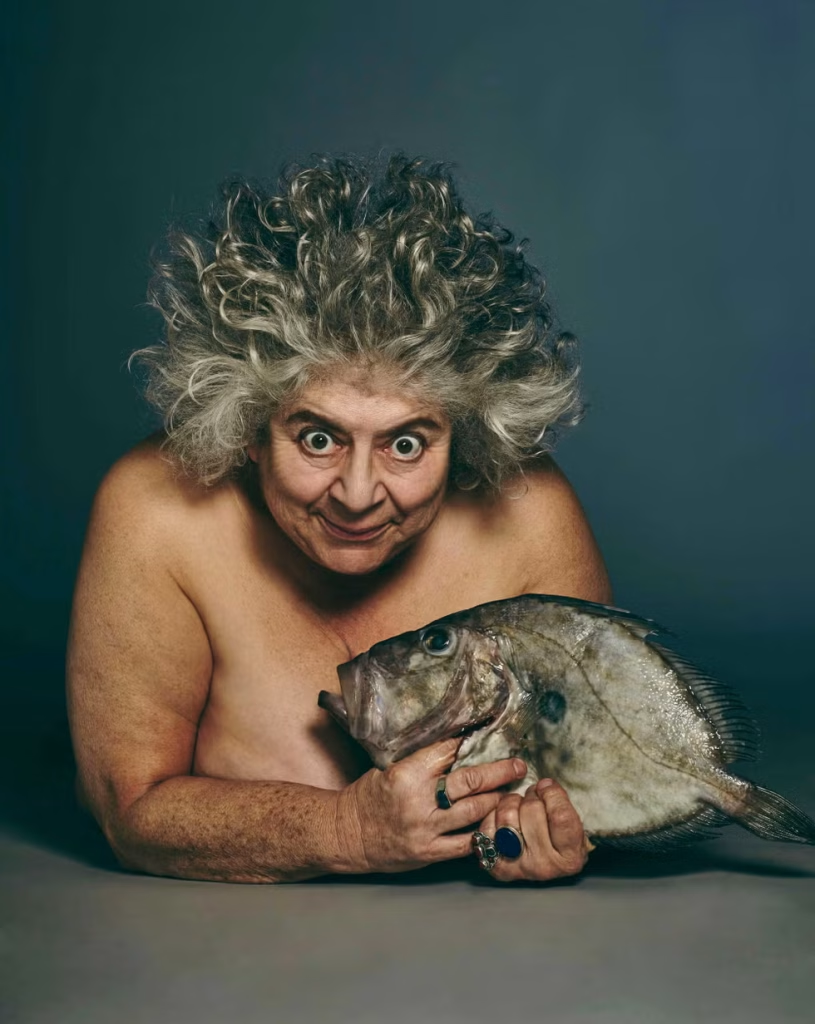
Lastly, what’s your favorite piece of LGBTQ+ culture, or a person who identifies as LGBTQ+: someone or something that’s had an impact on you and resonated with you?
“Miriam Margulies. I have a photo of her naked holding a dead fish in my bedroom. I think she’s everything a queer icon should be. She’s opinionated, hilarious, and doesn’t give a fuck. Those are qualities I really admire. I care too much about everything, but I’d like to be more like Miriam one day.”
By James Kleinmann
Pillion opens in select theaters in New York and Los Angeles on Friday, February 6th, 2026 from A24 before expanding nationwide.
If you feel inspired after watching the movie, visit The Leather Man at 111 Christopher Street, New York for all your S/M-leather-fetish clothing and gear needs, or order from their NSFW online store.


Leave a Reply