

Despite being overlooked by some major US film festivals like SXSW and Sundance, perhaps due its potentially controversial themes, writer-director Elliot Tuttle’s intense and intoxicating Blue Film has found its way into theaters this weekend, and is already one of the buzziest and most acclaimed queer releases of the year. No doubt independent film bodies will be taking note come awards season. While the film’s fledging distributor, the “filmmaker focused” Obscured Releasing founded by RJ Millard and Bill Guentzler, is already proving itself to be a vital part of the Northern American independent movie ecosystem.

Blue Film marks not only a remarkable debut feature for its filmmaker, but also for British actor Kieron Moore (Boots) who gives a searing tour-de-force opposite Tony-winning stage and screen veteran Reed Birney (Mass). The riveting chamber piece sees a cocky findom (financial domination) camboy, Aaron Eagle (Moore), leave the protected environment of his livestreams to spend the night with one of his admirers, a much older anonymous man, Hank (Birney), in return for $50,000. Before long, it transpires that these men’s pasts are potently connected. Hank was Aaron’s middle school English teacher and left in disgrace when he was convicted of the attempted sexual assault of one of Aaron’s 12-year-old classmates. What ensues is a compelling confessional, as each man’s mask drops and they share their intimate thoughts on sex, shame, and spirituality. Read our full ★★★★ review here.

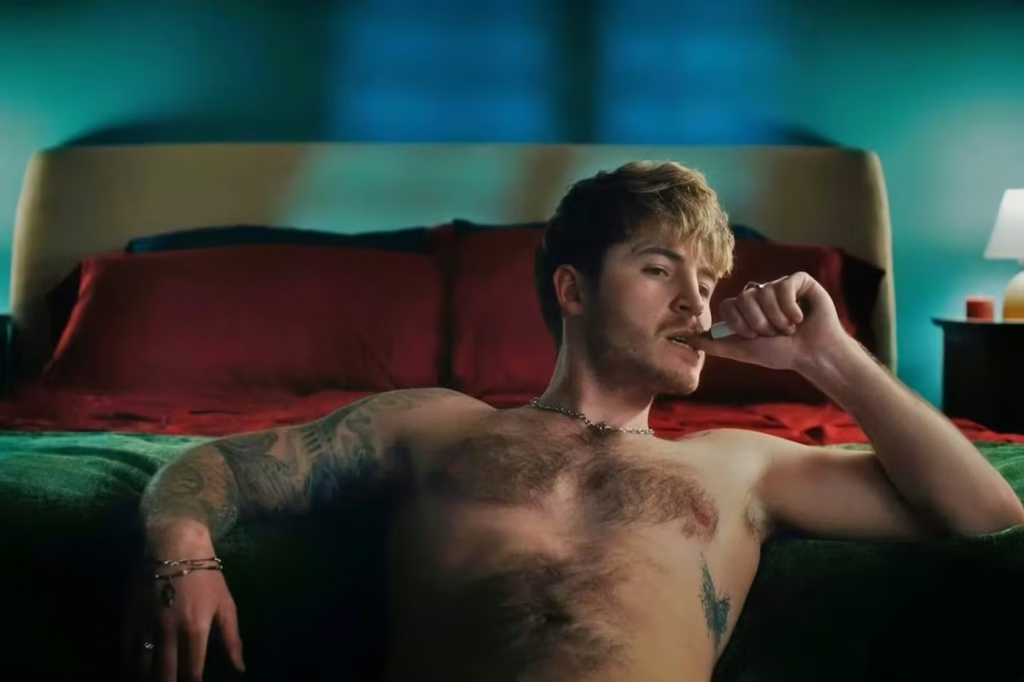
With Blue Film now playing in New York City, Los Angeles, and Palm Springs, expanding from May 15th, Elliot Tuttle and Kieron Moore speak with The Queer Review’s editor James Kleinmann about what led to their collaboration, how the film respects its audience, and the queer works that inspire them. With exclusive photography for The Queer Review by Mettie Ostrowski. Kieron Moore wears Tito Crichton-Stuart styled by Michael Miller.

James Kleinmann, The Queer Review: Elliot, when did your passion for film first emerge and how did that lead to a career as a filmmaker?
Elliot Tuttle: “I was about 11 or 12 when I started to get into film criticism. I didn’t even necessarily care about film that much at that time, but I loved reading criticism and the idea of people assigning numerical grades to movies fascinated me for some reason. So I started watching a million films and by the time I was 13 I had a movie review website. It’s not up online anymore, but I do still have all of the reviews saved on a Google Drive. Growing up, I watched so many films with my dad and I wanted to be a film critic for a really long time. I’ve always loved to write and I started writing my own scripts when I was a teenager, but it wasn’t until I was thinking about college that I thought maybe I wanted to make films. So I decided to go to film school and now I’m here.”
Quite a few critics have made films over the years haven’t they?
Elliot: “Yeah, it goes hand in hand, for sure.”

How about you Kieron, what was your journey to acting and when did you decide that you wanted to pursue it professionally?
Kieron Moore: “I’ve always loved film. As a kid, I used to sleep really badly. I used to have night terrors and I was probably one of the only kids who was allowed to watch movies all through the night because it would get me to sleep. I know so many films back to front because I’d keep them in the DVD player for a week at a time and watch them each night. I’ve always been massively drawn to cinema. It’s always felt like a haven. On all of my birthday parties as a kid I wanted to go to the cinema. That’s where I wanted to be.”
Elliot: “Me too! I made everyone go to the movies on my birthday.”
Kieron: “At that time, I didn’t know the effect that film was having on me. It was always a subconscious desire. I went to a very small public school in Manchester and we did little renditions of plays and musicals, but nothing crazy. Much later, when I knew that I was going to quit boxing and I was falling out of love with that—having been told that it was going to be my life—I dabbled in a bit of modeling. I was broke and needed the money. But I found myself really falling in love with the idea that every time I got given a different outfit to wear I was being a different person. I got used to the camera and started to think, I could do this. But I didn’t know how to get into it.”
“When I finally quit boxing, I was working at my day job and I was very low, thinking, is this it? Then I had a bit of an epiphany. In all honesty, I was sat crying in my car being like, I thought I was going to do something special. I said to myself, what are you good at? And I was like, well, I’m really good at being what people want me to be. That’s acting. It’s not like I’m proud of it, but I was a good liar and I was good at being what I wasn’t and hiding my feelings. So I told myself, I’m going to be an actor. As soon as I’d said out loud, I knew it was what I wanted to do for the rest of my life.”
“Acting is the first thing I went after in my life that I wanted to do just for me. I Googled how to be an actor in Manchester and found three schools. Only one of them you had to audition for and it was for a two-hour class on a Thursday after work. The rest is history. I still work with my acting coach. I’m very good at falling in love with something, perfecting it as best I can, and then letting it go. Whereas with acting, I’m realizing I can never perfect it. I can only ever get better. I can only ever learn more, but it only gets harder and harder and I fall in love with how hard it is.”

What age were you when you were watching movies overnight?
Kieron: “Since I was very young. I had night terrors from when I was five up until 16. I realized as I got older that my parents had really good taste. They put me onto some great music and some amazing films. Maybe I was a bit too young for some of them at the time, but these films have stayed with me. Now I’m in these conversations where people talk about their favorite movies and I’m like, ‘Oh, my parents showed me that.’ They aren’t cinephiles by any means, they’re just huge consumers who love film and TV.”
What was something that they showed you that has stuck with you?
Kieron: “I watched Guy Ritchie’s Snatch when I was about seven and I remember being so engrossed by it. These films were introducing me to great music too with their needle drops. “Golden Brown” by The Stranglers is one my favorite songs. I’m very lucky that England’s got some great cinema and my parents allowed me to discover so many incredible films not realizing it would birth this beast in me.”

You mentioned the plays and musicals at your high school. I read that when they were doing Grease you were tempted to be involved but avoided it. Then when you first started those Thursday evening acting classes you kept them secret. Why was that?
Kieron: “Fear. Going back a bit, I did a school play when I was seven years old for an audience of about 12 parents. It was set in the Victorian era and I played a teacher and also a vagabond. I absolutely loved it. There was one bohemian family at the school and the parents were like, ‘You should take him drama school’. I heard that and said, ‘I’m going to be an actor’, but my dad was like, ‘No, you want to be a boxer’. Then I forgot about it until my high school was doing Grease.”
“I was always getting asked to do school presentations or if someone important, like the Prime Minister, visited I would be asked to show them around the school. Looking back now, that was all acting. When Grease came along, I knew I had the right hair for it and I was like, ‘I’m going to do it. I want to play Kenickie.’ I went to the audition, with a leather jacket on and my hair done, but then all of my nemeses from the football team walked past. Because I was a boxer, everyone wanted to prove how man they were around me, but I was a very gentle kid. Seeing them, I realized that I couldn’t do it in front of them. I had a deep fear. I was aware enough then to know I was scared of them.”
“I watched the rendition of Greased Lightnin’ in the final show. James Mellon played Kenickie and all I could think about was how it would have been better with me in it. Sorry, James Mellon! So I just let acting go for a while after that. But when I first started those classes, I was a bit misbehaved and already putting my parents through a lot as it was, so I didn’t tell anyone. Then I finally had to because my mum thought I was getting in trouble on those nights. When I told her what I’d been doing, she was like, ‘Your head’s full of magic.”

Did she mean that in a good way?
Kieron: “Not at the time. We had a big argument and she was like, ‘Your head’s full of magic. Get a real job!’ She was just scared for me. Then when I got my first series regular role, my agent called my mum on FaceTime and said, ‘His head’s full of magic.’ Now, every time I get a job or I do something special, my mum writes me a letter and signs it off with, ‘Your head’s full of magic’. I’ve got those words in her handwriting on my arm now as a tattoo.”

That’s beautiful. Let’s turn to Blue Film. Elliot, what were some of the things that were on your mind as you set out to write the screenplay?
Elliot: “Adolescent sexuality. I was watching a lot of Catherine Breillat films, like 36 fillette and Fat Girl and thinking about my own adolescence while I was watching those films. I was journaling a lot at the time and the inception of the film was me journaling about my own adolescent sexuality. I was thinking about teachers I had fantasized about and then finding a natural extrapolation of what I was actually fantasizing about.”
“Being a gay man living in a major city in today’s world, a lot of the idiosyncrasy that is in the character of Aaron is very personal to me. Then Hank became this discursive figure in the film. It’s definitely an echo chamber between the two of them and that was always something I wanted to do. Along with all of the thematics, something that was also on my mind from the beginning was how I wanted to make the movie. I wanted to make something that I knew was really producible by design.”
“I wanted the film to be an echo chamber of these two self-proclaimed perverts. I wanted to make something that establishes a unique relationship with each audience member. I think each audience member will meet the film where they’re able to meet it. That was something that I was thinking about from the beginning, asking myself, if I can make something for no money how do I maximize its impact? Those were all factors when I first started writing. It was about how I wanted to make it just as much as why I was making it.”

I love how the film allows the audience to have their own individual dialogue with it.
Elliot: “Those are my favorite films. Films that are so personal and vulnerable that it forces you, the individual audience member, to form a relationship in some way with the film.”
Getting the casting right is always a vital part of any film, but when it’s a two-hander it’s even more critical. You’d already cast Reed as Hank, what appealed to you about casting Kieron opposite him as Aaron?
Elliot: “They had immediate chemistry together and Kieran really blew us away. It’s so difficult doing chemistry reads over Zoom, but unfortunately it was necessary to our process of making the movie. I wish we could have done them in person, but nevertheless you could feel the chemistry between them from your computer and now Reed and Kieron are great friends.”
“Reed had always been my first choice for Hank and he was the first actor we went out to. He’s such a huge talent. We did chemistry reads with Reed with a bunch of young actors who all brought something different to the part. But Kieron lent so much of what I love about the character to Aaron. It’s really difficult to imagine what the film would be without either of them. Their performances are 100% the thing I’m most proud of in the film.”

Kieron, what was your initial reaction to the script?
Kieron: “My manager sent it over and—in more vulgar terms—said something like, ‘I don’t know if anyone’s got the balls to do this, but I think you might have.’ I read it and it was such a page-turner. I was so into it I forgot I’d put the kettle on. I was immediately mesmerized.”
“I’ve been very lucky so far. Maybe it’s my great team or my own taste, but a character has always met me at a time when I needed it and allowed me to channel what I had in the trunk that needed to come out and what I wanted to explore. Aaron found me at just the right time. I was very interested in shame and perversity and my own ideas about myself. I immediately connected with the script, but I was also so surprised with every page. I never knew what was coming next.”
“I read it three times back-to-back and then I said to my acting coach, ‘I think this could be the one that I’ve been waiting for.’ I went back to my manager and told him that I had to read for it. I was obsessed with it. Then I found out that Elliot was only 23 when he wrote it and I felt really bad about myself! I was like, this kid is a genius. I’m a big fan of words, of authors and wordsmiths.”
Elliot: “Kieron came into the chemistry read with Reed talking about a book that he’d just read on perverted ideology, which really impressed me.”
Kieron: “Yeah, I had my Lana Del Rey top on inside out for that chemistry read because I couldn’t find a plain black vest. At the end, Elliot said that he could still see what was on it and told me that I should’ve turned it around! I read a lot and try to keep things eclectic. I told Elliot that I’d read a book called Perv: The Sexual Deviant in All of Us by the psychologist Jesse Bering which blew my mind. He explores all these very niche kinks, but one of the massive themes of the book, which he explains at the beginning, is age. That is what the last chapter is focused on.”
“One of my favorite books is Nabokov’s Lolita. I think it’s a remarkable piece of writing. More books than you would imagine touch upon this theme if you actually dive into literature because it’s been ingrained in human culture since the dawn of time. I was fascinated by that. I think Elliot’s made a beautiful film, his direction is incredible and so is Ryan Jackson-Healy’s cinematography and Reed’s performance in the film. But before all that had happened, I knew immediately that this was an actor’s script. If you take away the premise, any actor who says that this isn’t a role that they’d want is a liar, because we all want complexities and this is rife with them.”

What was your approach to playing Aaron and was there anything specific that helped you to unlock him?
Kieron: “I was much bigger back then because I was getting ready for Boots. I was 210lbs and I’m only 5’11”, so I was a big boy. I’m actually quite body conscious compared to Aaron and that side of him was fascinating to me. There’s this line the movie where he says to Hank, ‘If you looked like me you’d want to be naked all the time too.” I can’t associate with that myself, but I felt that there was a way in there along with how he moves his body.”
“I’ve been around men using their bodies and taking up space since I was five years old in boxing gyms. So I’m no stranger to that flaunt of masculinity and the peacocking. That was a real dive in point for me. I was like, okay, if I can feel like him and get used to my skin that’ll be a passage to playing him. Inspiration for him was everywhere, but originally I spoke with four of my best friends who part of the gay community. I was like, ‘Do you think I could do this?’ I wanted to get their thoughts on it and I’m very lucky that I have friends who are willing to open up about their lives to me.”
“It’s every actor’s responsibility to see the world through the character they’re playing. So I did check out content creators, but I wasn’t as much consuming their content as looking at how they were selling that content. That’s what I was massively fascinated by. I was looking at their Instagram, their Twitter or their TikTok, whatever they were using to get you to click on that link. One of my friends is a content creator and I said, ‘If you could give me one piece of advice, what would it be?’ They said, ‘You always have to make them believe that the next purchase will give them what they want.’ That is something that I’ve carried with me. That helped me to see that it’s an exchange, and we are all selling something.”

One of the fascinating aspects of the film is the peeling back of the mask with both of these characters, especially at a time when we are so saturated in social media with people creating personas that don’t necessarily match who they are offline.
Elliot: “So much of the engine of this film is sustained by that dissonance between one’s true self and one’s assumed self. That’s what the entire movie is driven by in every narrative beat. It was hugely on my mind. I asked myself, how do I sustain this two-hander for a feature length? And that’s what is sustaining it.”
Kieron: “Elliot’s direction, especially in those little moments, gave me so much. When you’re in a scene as an actor you’re really immersed in it and you’re navigating it, but because of Elliot’s vantage point he could take on the role of the consumer of the content in a sense. So there would be moments where Elliot would come over to me and be like, ‘Turn him on, make it about him.’ He’d give notes like, ‘Allow this to turn you on.’ With those kind of directions something wonderful happens where you go, okay, I’m just going to free fall into this idea.”

When it comes to being taboo-busting, transgressive and subversive, it’s not so much about the film’s imagery, but the fact that you allow these two characters to talk openly without a judgmental lens.
Kieron: “We’re so used to being told what to think in cinema and everywhere. We don’t tell you what to think, we let you do the thinking.”
Elliot: “I think that’s true and that’s also what a lot of my favorite films do. It’s about being immersed in something. It’s the filmmaker’s emotional, vulnerable projection and you get to sit in it. When you walk into a movie theater you are giving up control, not only of your time, but you are watching what is being projected for you. If people want to leave the movie, they can. My friend made a TikTok about that, telling people that he was very moved by the movie and saying, ‘You don’t have to see it if you think it’s not for you, but if you’re willing to meet it, I hope that it moves you.'”

I was talking to Richard Gadd recently about his series Baby Reindeer and Half Man and in making challenging work how much he is considering the audience, both in terms of a responsibility of care, but also treating the audience as adults, which feels pretty rare in film and TV right now. I think the success of his work, and the reaction to Blue Film so far, goes to show that people are willing to engage with difficult subject matter. I’d love to pose the same question to you Elliot.
Elliot: “No filmmaker should be making films for just themselves. You have to make something for an audience. They’re the people that are watching your work, so you have to think about them all the time. I do think that there is a responsibility of care for them, for sure, but we should all be treating the audience as adults. I’m sometimes asked or see comments like, ‘Why did we have to make this movie now?’ Or ‘Did this story really have to be told?’ Which feels like they are missing the point. No story has to be told. Artists can make any story. It’s a personal expression that’s usually cultivated over a number of years.”
“There should always be a huge respect for the audience and at the same time I want audiences to critically engage with the work. I think we have lost the plot of how morals need to be aligned with film. No film has to render morality perfectly. It’s not a guidebook for how to live your life. It’s art. Everything would be so boring if the discourse was controlled like that. It’s not the liberal take that these people think it is. It’s kind of fascist in a way. The idea that if something doesn’t align with someone’s view of how it should be, it should be thrown out. That’s not any way to engage with art.”
Kieron: “What’s so powerful about our movie is that the last part of the puzzle is the audience. You paint the full picture.”
Elliot: “I would hope that is the ultimate respect for the audience.”

The film looks incredible, what were your guiding principles for creating its visual language, including the layering of home video and the DV footage Hank is recording?
Elliot: “One thing that was essential to the esthetic world of the film was the camcorder and MiniDV footage because it’s either used for home videos or snuff films. So it felt perfect because it was all about creating an environment that is at once intimate and scary. It took a lot of thought and preparation to try to achieve that balance because those things don’t necessarily go together; intimacy and feeling off put. That esthetic was really important to creating a familiarity and an intimacy while keeping the audience on the back foot.”
“We really wanted to use color, that was so important to me. Pedro Almodóvar and Aki Kaurismäki are geniuses with color. They use it in really expressive ways. Bergman does too. There are moments when the entire screen will go red. It’s a projection of pure emotion. I really wanted our film, despite the limitations financially, not be afraid of color and that one tone of blue is gorgeous.”

I love the score and your sparing use of it.
Elliot: “Isaac Eiger, our composer, is so inspiring. A film score needs to push the narrative further, it can’t simply accompany. Isaac and I were so on the same page when it came to deciding on the few moments when we use music and how it should feel. I loved talking to him about music and sending stuff back and forth with him. He created this rattling, echoey score. It’s all meant to be invisible work that makes you feel something. The music is meant to drive everything that the esthetics are doing.”
“Everything that you’re doing in post-production is about building a world. You only have the image and the dialogue, so you need to create entire lived-in worlds that these people conceivably exist in. I loved doing that. Our sound designers Matthew Rollins and John Michael Keville are phenomenal too.”
The film starts with, “what’s up, faggots”, a word that Aaron uses liberally but Hank is uncomfortable with. Elliot, what’s your own relationship with that word?
Elliot: “I use the word faggot all the time in my daily life. I call my straight friends faggot. I have called all of our producers faggot at one point. I use it in the way that…”
Kieron: “It’s like how I say, ‘darling’.”
Elliot: “Yeah, it’s a salutation. One thing that’s fun about using that word so much is that it’s such a loaded term. It’s a term that, despite being used a lot in queer circles, has not really lost its sting. It’s also very authentic. Watching all of these cam guys, you cannot escape that word. Watching these findom porn videos you cannot escape someone being like, ‘Lick my feet, faggot, and send me $100.’ It’s pervasive. Gay people have heard it a million times in derogatory ways as well as sexual ways in the bedroom. It’s a very flexible term.”
Kieron, as you forge your own acting career, is there an established actor who whose career you look at with admiration in terms of the choices that they’ve made over the years?
Kieron: “This is a recent revelation. Up until about six months ago, I was constantly looking at other people’s careers and being in awe. But now I’ve started to be like, I don’t want anyone else’s acting career, I want my own. Which feels really powerful and I can’t believe I’m even saying that out loud. There are many jobs that I wish I could have done, but I realize in hindsight that it has more to do with me loving what that person who was cast did so much that I wish it was mine. It’s about a deep respect.”
“There are definitely actors who have and will continue inspire me and I will always watch everything they do. But right now, I’m trying to be the best actor I can be. I’m trying to be my own favorite actor. So I have to pay more attention to what I’m doing now and try to carve my own way. Everyone is great at what they do because it’s them doing it. So I try to find some confidence in the fact that what I do is what it is because it’s me doing it.”
“I look at people like Robert Pattinson, who has had a great career. He did that commercial thing and got what he needed to from it and then dipped off and did all these incredible indies. Now the mainstream media is like, ‘Where’s he been?’ This guy’s been great for 15 years. He’s done some really serious work. Then there are greats from across all time that I love. I really resonate with old school actors like Paul Newman where there was such craftsmanship. They didn’t learn their lines, they studied them. I feel like that’s where I sit. I love it so much. I’m going to carve my own path and this is the first door to open for me. It’s given me the gift of my first feature and hopefully there’ll be many more.”

Final question, what’s your favorite piece of LGBTQ+ culture, or a person who identifies as LGBTQ+; someone or something that’s had an impact on you and resonated with you over the years?
Elliot: “There are so many, but I’m trying to avoid the more obvious choices like Monika Treut, Fassbinder, or Pasolini. Instead, I’ll pick a queer film that I saw very recently that I loved called Girl with Hyacinths. It’s a Swedish film from 1950 directed by Hasse Ekman that is one of the most beautiful portraits of queer longing that I’ve ever seen. It’s streaming now on the Criterion Channel under their Nordic Noir section. It was really moving to see this prescient vision of things that would not be made elsewhere for another 40 years that was made in Scandinavia in the 50s. It’s so gorgeously performed and made. It was astounding to me.”

Kieron: “All of the queer artists I get to meet inspire me. My acting coach, Mark Hudson, is such a strong representation of queer artists from where I’m from. He’s a 65-year-old gay man who has lived a very different life to me, but he’s become one of my best friends.”
“When it comes to books, Oscar Wilde is one of my favorite authors. What he was doing with that pen is going to stay with me for the rest of my life. The Picture of Dorian Gray is incredible, but I recently came across a short story by Wilde called Lord Arthur Savile’s Crime. What he achieves in those 55 pages I was absolutely blown away by. It’s about this lord who gets a palm reading that predicts that he’s going to do something horrific. So it explores whether or not we are in control of our destinies if we’ve been told our end point.”
By James Kleinmann
Blue Film is now playing in New York, Los Angeles, and Palm Springs from Obscured Releasing expanding from Friday, May 15th. Filmmaker and actor Q&As at select screenings at IFC Center and Landmark Sunset.

Leave a Reply